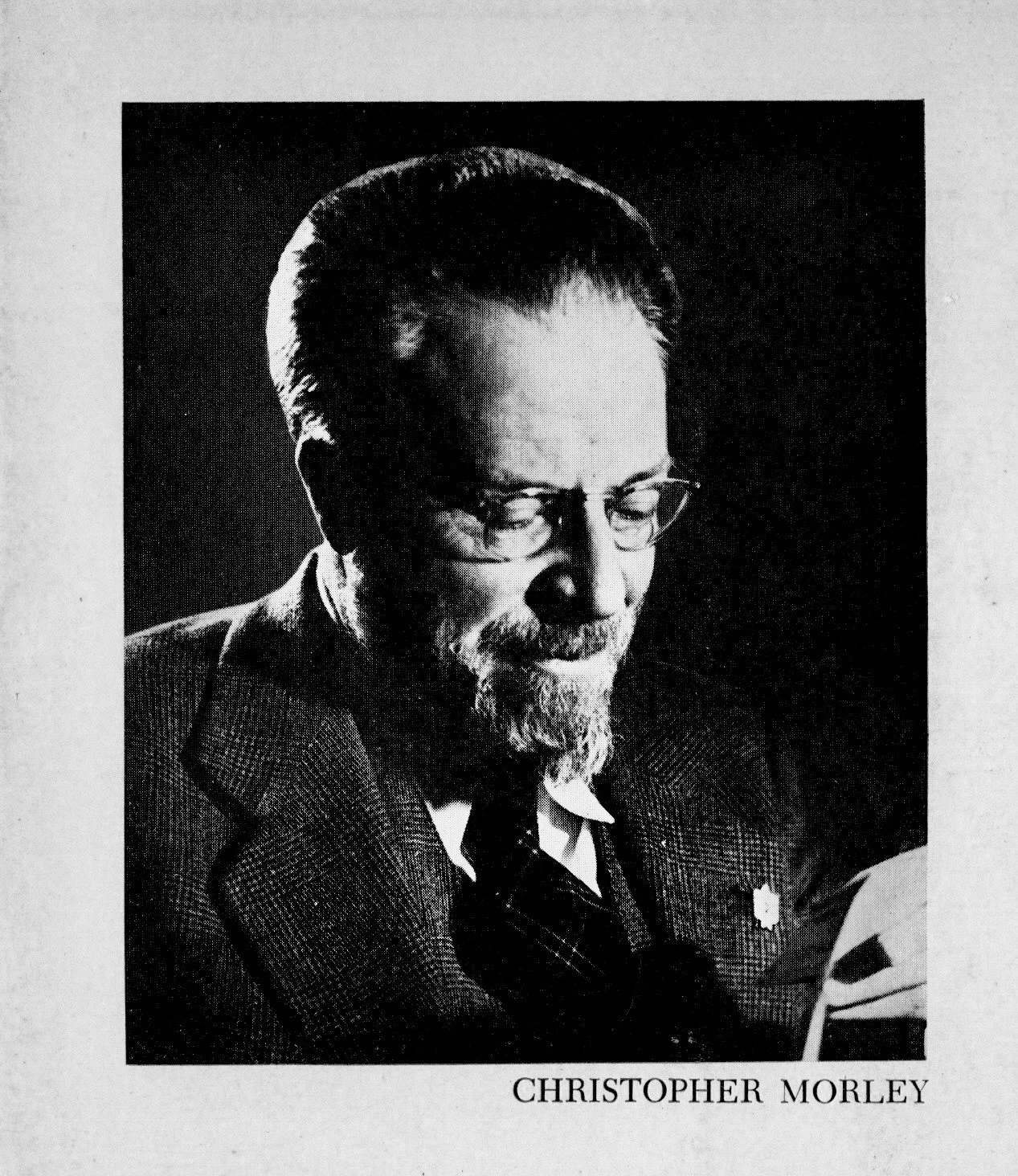
"Good-by Chris"
The recent passing of two dear Sherlockian friends, Jacqueline Bost Morris and Doré Nash, has left me rather melancholy. Both played The Sherlockian Game with joy. Jacqueline, in particular, was a dear friend. We spent many happy hours with friends at the Grand Central Oyster Bar, McSorley’s and other fine places surrounded by fellow Holmes admirers.
A caricature of Morley by Chicago artist and writer Gene Markey.
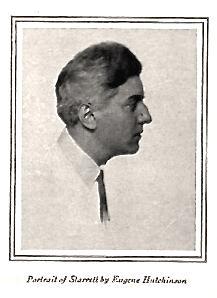
Naturally, I turned to the shelves for comfort and found myself pulling down a scrapbook of Vincent Starrett’s writings.
Flipping through its pages I found a column by Starrett which offered a dram of solace. For there, on the page before me, was the yellowed essay Starrett wrote as his “Books Alive” column for the April 14, 1957 issue of the Chicago Tribune. It was his farewell tribute to his friend, Christopher Morley.
You’re going to see that column in a couple of different forms here. To make it easier to read, a full transcription makes up the bulk of this post.
I’ll add a few thoughts at the end. See you there.
I can’t remember when or where I first met Christopher Morley unless it was some centuries ago at the Mermaid Tavern. Possibly, in this life, it was at one of Burt Massee’s colorful brawls for visiting authors or at Ben Abramson’s historic Argus Bookshop, where he courted writer’s cramp whenever there was a new Morley title in the market.
We exchanged letters for a time before we met, our correspondence dating from my enthusiastic review of “Where the Blue Begins” in the old Chicago Evening Post—obviously a good beginning for a literary friendship. Thereafter we convened when opportunity offered, in Chicago or New York, and talked torrents of pleasing nonsense until train time put an end to the adventure.
He was a big florid friendly man without swank or condescension, pleased but not spoiled by the success that had come to him. He liked being an author; and he was the only writer I have ever known who seemed to me to fulfill the role of man of letters with the humor and dignity of a great tradition. It was one of his many strokes of pure genius to grow a beard.
* * *
If ever it becomes necessary to establish my whereabouts—in bookshop or tavern—on certain days of the irrecoverable past, I can find corroborative detail on the flyleaves of books, old menus and wine lists, signed and meticulously dated by Morley as a sort of fossil record of our miscellaneous exits and entrances on the margin of events. We began, and failed to finish, ballades on subjects popular with Villon and Herrick, ordered owls at Schlogl’s and rambled the streets of Old Loopy (his name for Chicago) like time-travelers on holiday in Bagdad.
Once, on a pious impulse, we taxied to Lincoln Park to drop a bay leaf at the grave of David Kennison, the last survivor of the Boston tea party; but in the early morning darkness were unable to locate the memorial stone . . . .
We had no superfluous leisure.
* * *
Others will write of his contribution to letters, his prodigious output in nearly every department of literature; but first and last he was a bookman, a literary cove. Inheriting the bookish tradition of the English essayists, he was at his best (and most genuinely himself) when reporting his pleasure in the writings of others—a generous trait. But time will discover in him, I think, a poet of charm and distinction and a novelist of gifts not to be measured by the debased standards of our immediate day.
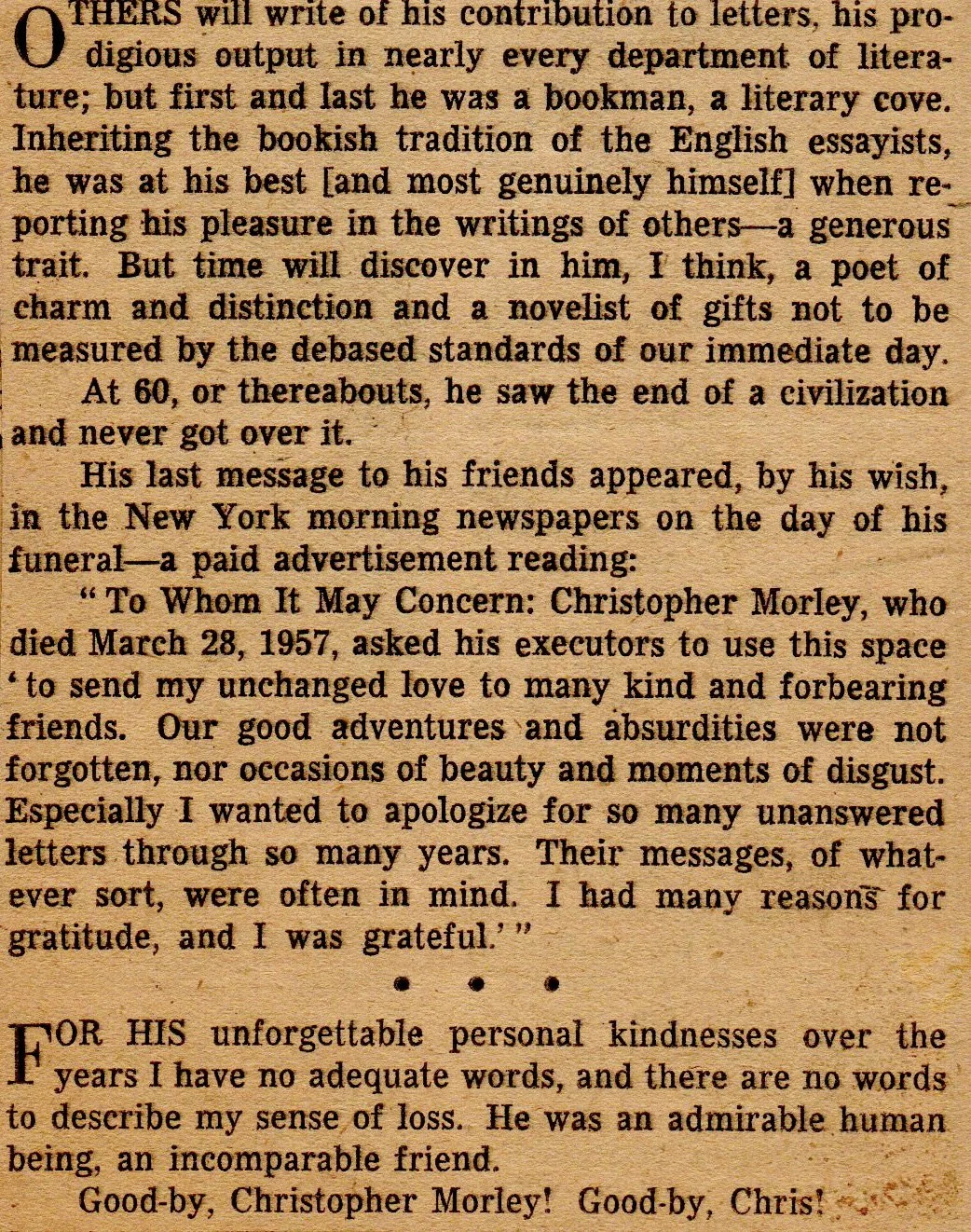
At 60, or thereabouts, he saw the end of a civilization and never got over it.
His last message to his friends appeared, by his wish, in the New York morning newspapers on the day of his funeral—a paid advertisement reading:
“To Whom It May Concern: Christopher Morley, who died March 28, 1957, asked his executors to use this space ‘to send my unchanged love to many kind and forbearing friends. Our good adventures and absurdities were not forgotten, nor occasions of beauty and moments of disgust. Especially I wanted to apologize for so many unanswered letters through so many years. Their messages, of whatever sort, were often in mind. I had many reasons for gratitude, and I was grateful.’ ”
For his unforgettable personal kindnesses over the years I have no adequate words, and there are no words to describe my sense of loss. He was an admirable human being, an incomparable friend.
Good-by, Christopher Morley! Good-by, Chris!
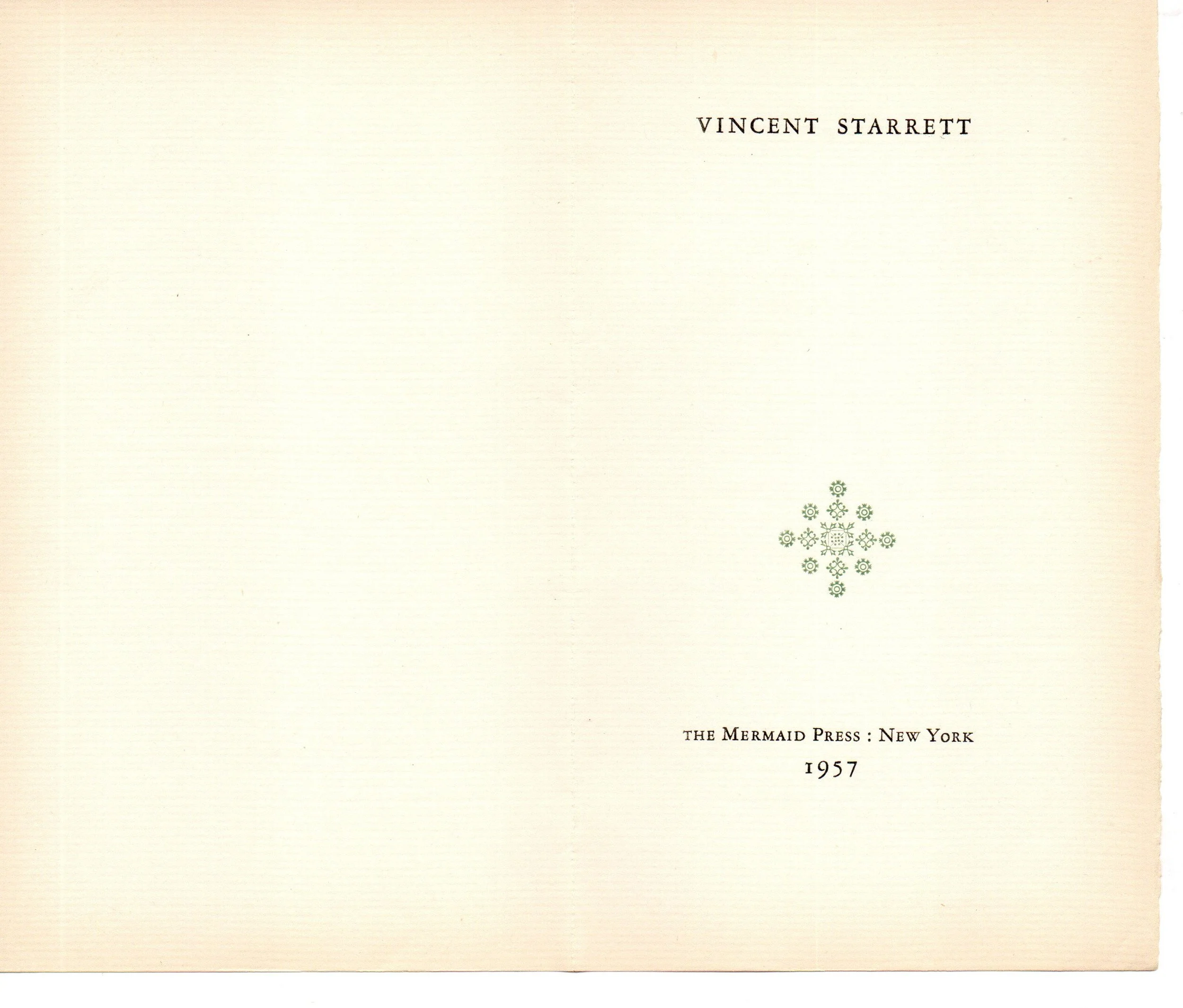
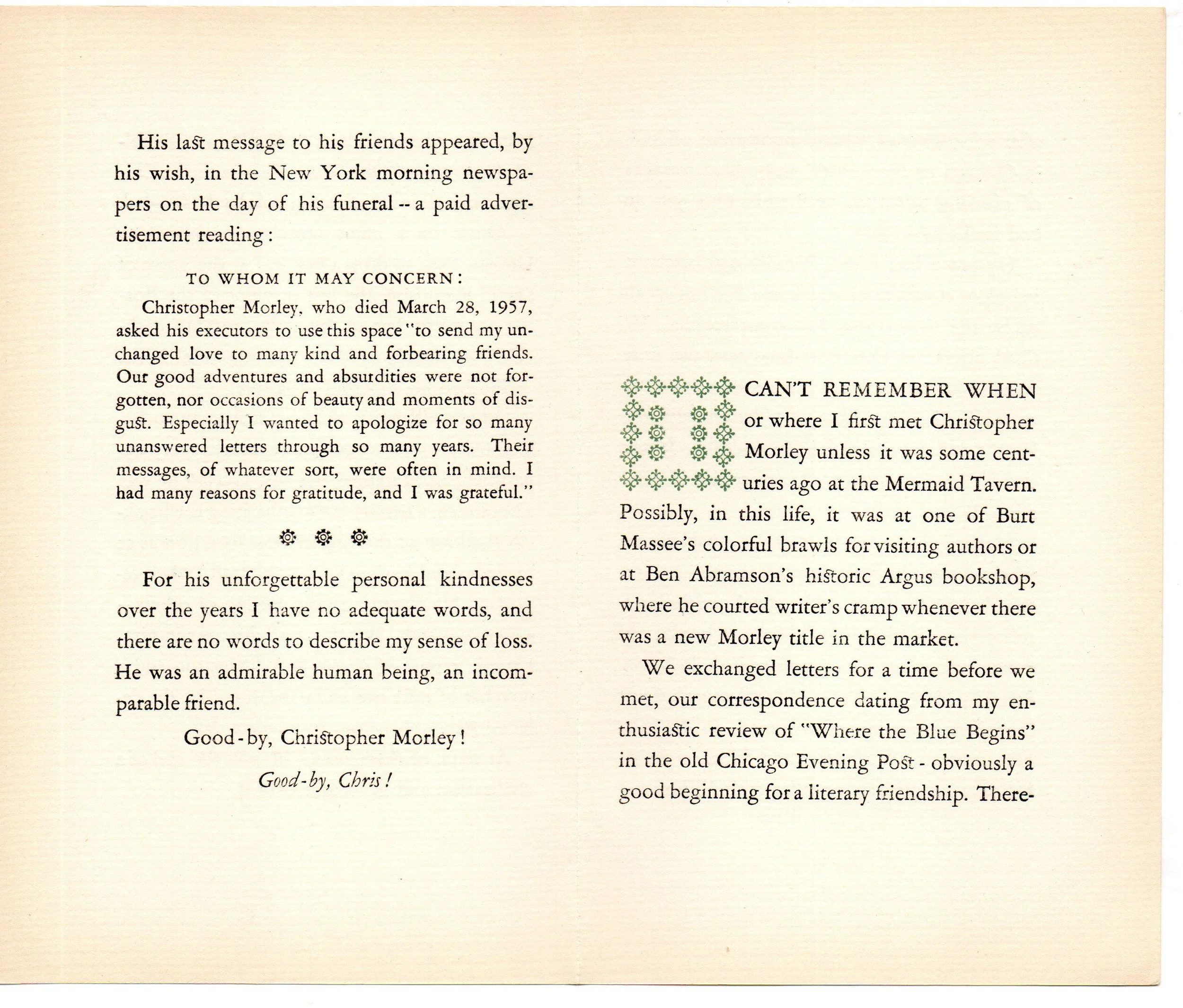
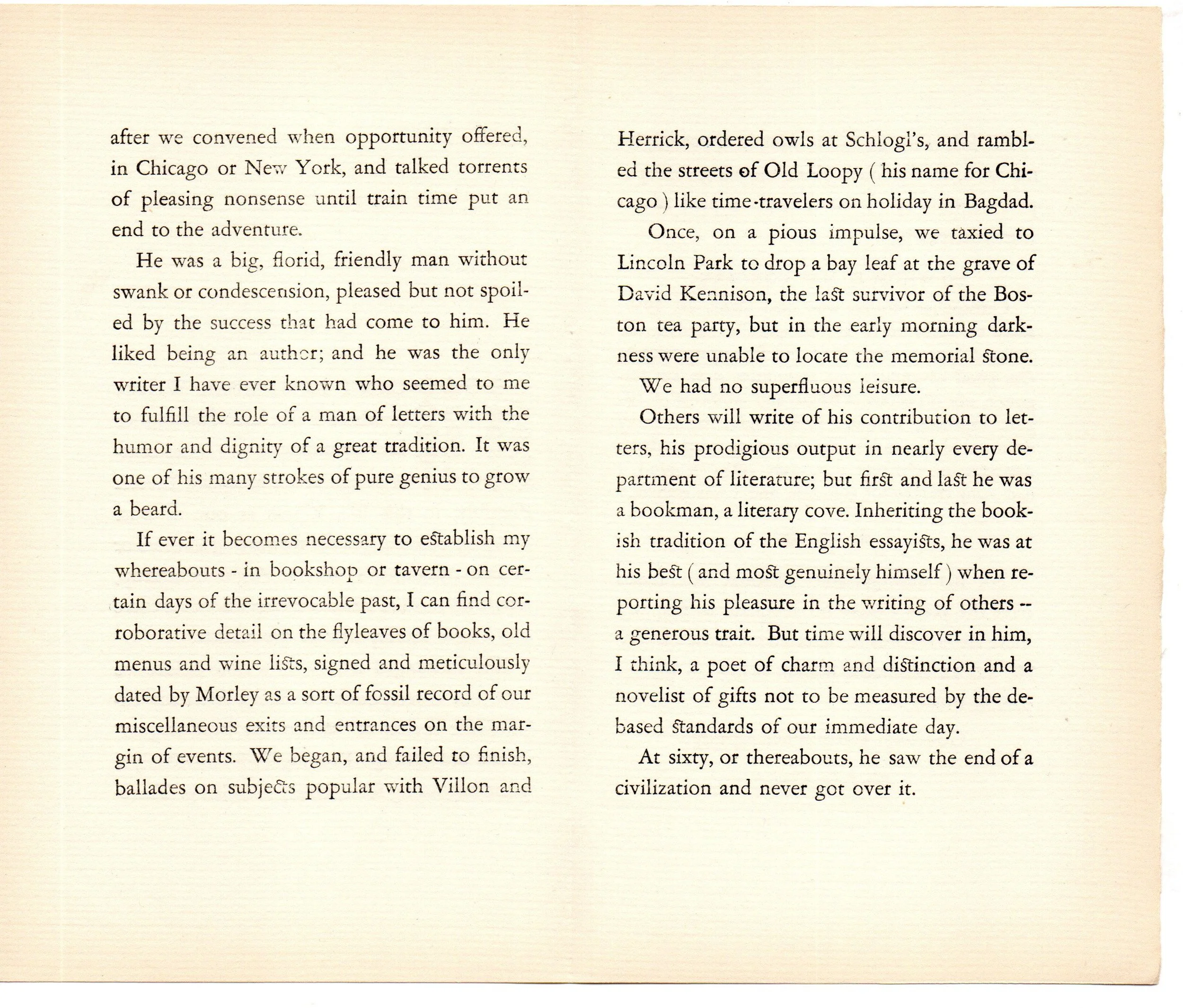
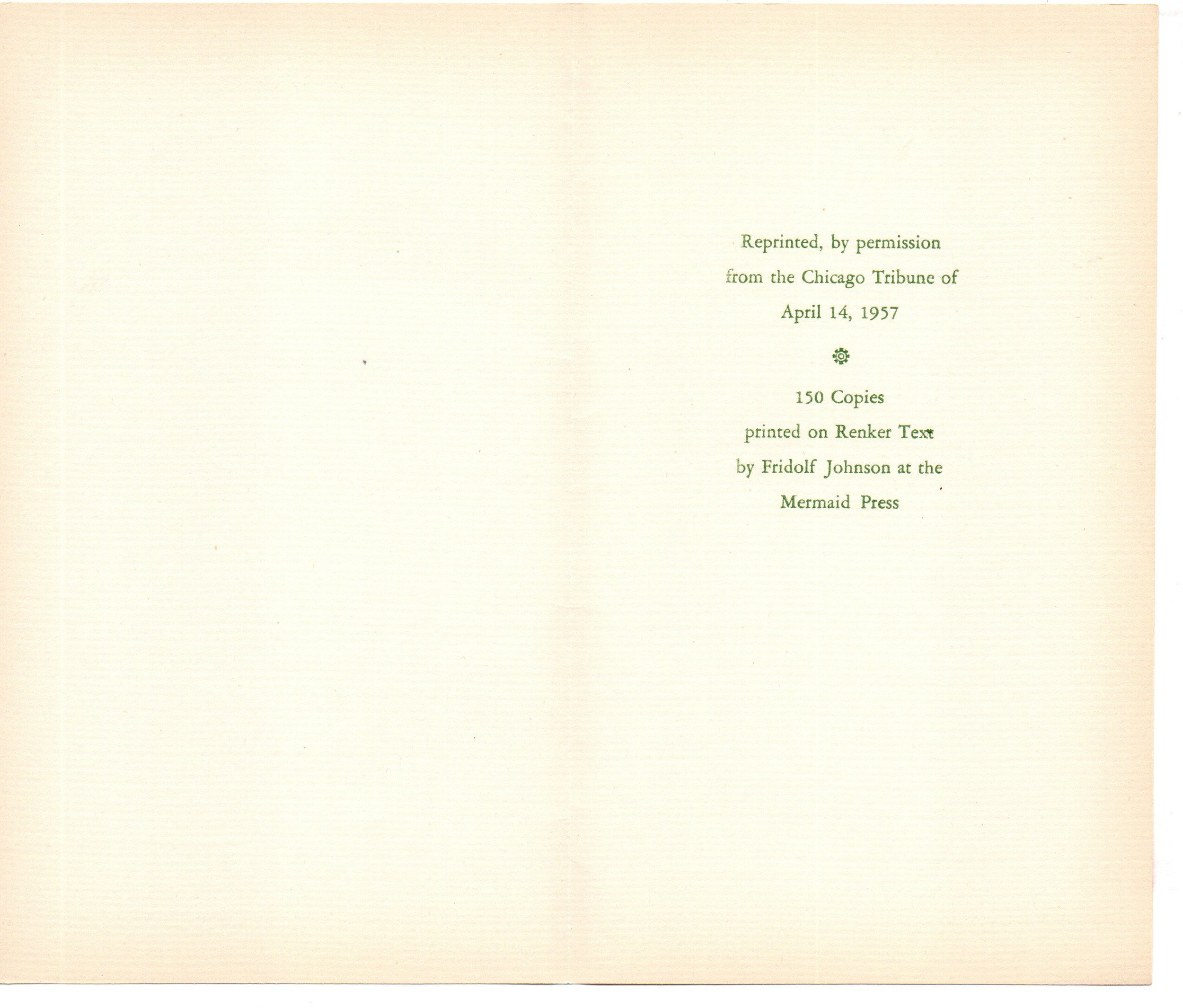
At some point, Starrett’s friend Fridolf Johnson, put together the sheets for a little booklet that reprinted this column.
There were to be 150 copies printed, but so far as I can tell, that never happened.
There appear to be a handful of incomplete, unbound leaves giving us a taste of what might have been.
I was fortunate enough to purchase a set of these leaves. It’s a shame the booklet was never printed. I’ve not been able to find correspondence that explains why it remained incomplete.
One of the joys of tracing Starrett’s life was finding out more about his friendship with Morley. Along with Edgar W. Smith, they were the three who helped found and guide the Baker Street Irregulars during its formative years.
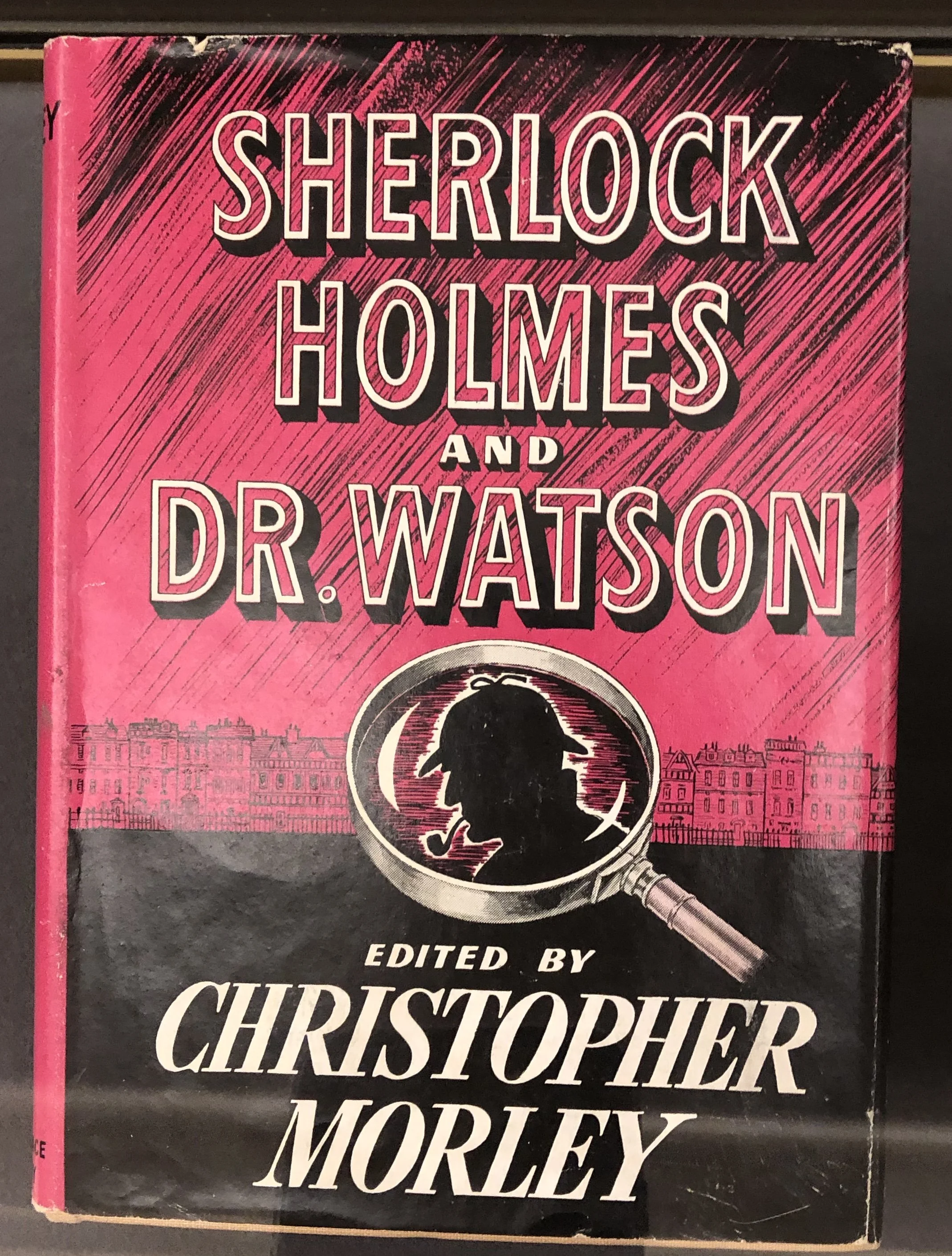
Morley left behind many books, including this often overlooked contribution to our hobby: The 1944 book, Sherlock Holmes and Dr. Watson: A Textbook of Friendship. It was intended to be useful to young readers new to the Canon.
That notion of “a textbook of friendship” has stuck with me over the decades. I can’t help but think that he and Starrett provided such a textbook for all of us who have followed them.
In that spirit, I hope you’ll soon find yourself with like-minded companions, talking “torrents of pleasing nonsense” and raising a glass to absent friends.
Good-bye Jacqueline! Good-bye Doré.