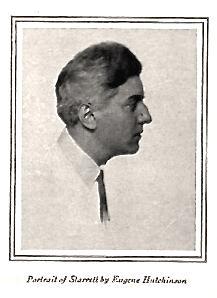
The Hunt For A Missing Movie
“Wanted—A Coward,” The Short Story
If you were going to make a Hollywood film today, I doubt that “Wanted—A Coward” would inspire much excitement. And yet, it was the cover story for a pulp magazine and turned into the first film based on a Vincent Starrett story. (The second was “The Great Hotel Murder.” )
Tracing the history of the tale isn’t easy.
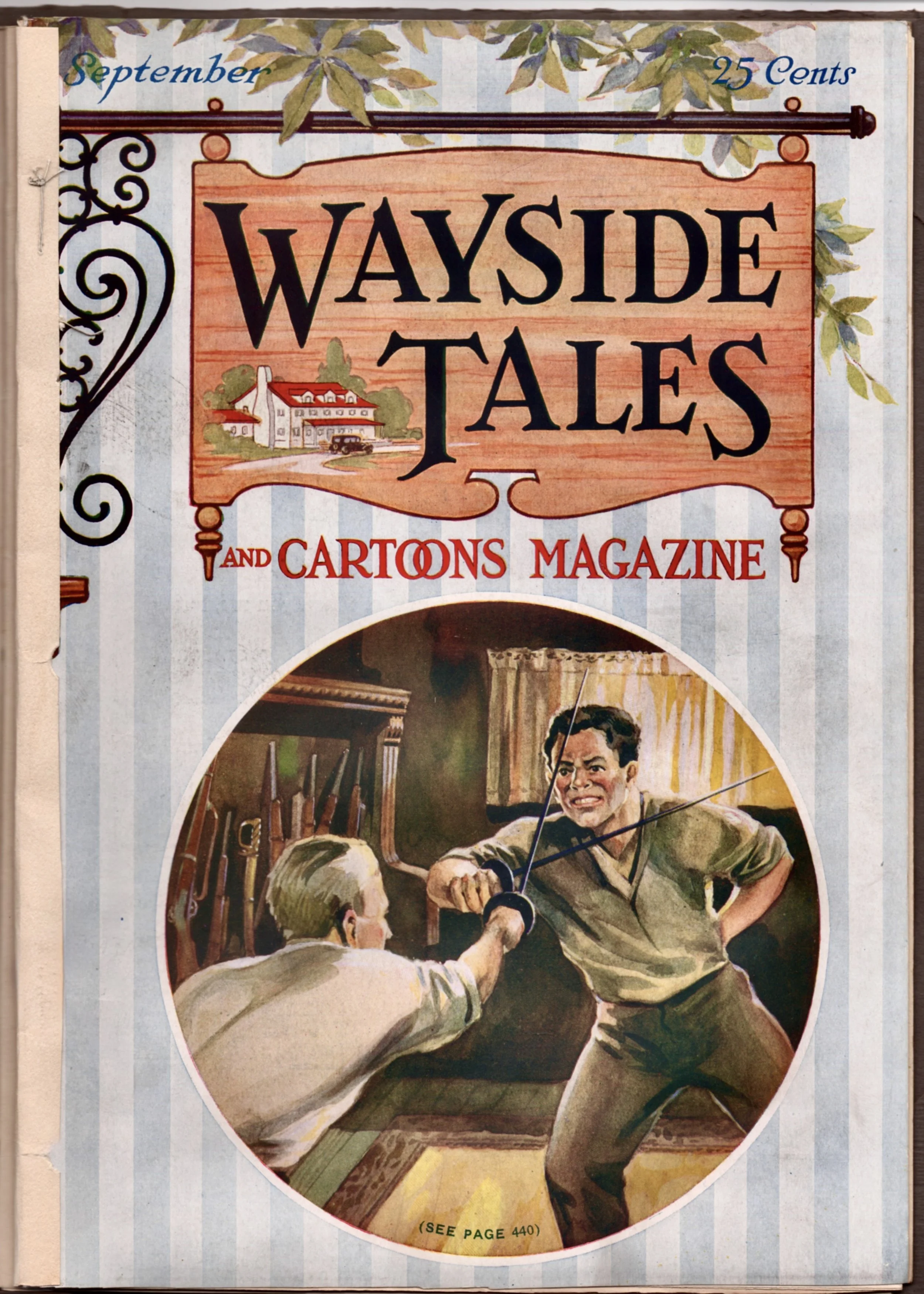
The cover to the August 1921 issue of Wayside Tales and Cartoons Magazine, featured “Tale of Three Suitors,” a Jimmie Lavender mystery. This cover image does not go with Starrett’s story.
Starrett’s short story itself is forgotten and it takes a little effort to track down. The author didn’t put it into any of his short story anthologies like Coffins for Two, The Blue Door or The Quick and The Dead. (I wonder if he signed away his rights when he agreed to the film.) Starrett also doesn’t mention it in his autobiography.
It wasn’t until Peter Ruber reprinted some of these stories in Wayside Tales, volume 12 in the Vincent Starrett Memorial Library, that contemporary readers could judge it for themselves.
Then there’s the movie. We’ll get into details a little later, but if a copy of the six reels still exist, they are in the files of the Library of Congress. (I imagine their storage would be like something from that last scene in “Raiders of the Lost Ark.”)
All is not lost, however, We can trace some elements of the story as it made its way through the world of print and film. Pull up a chair, pour yourself something choice to drink and let us see where the trail leads.
The first page of Starrett’s tale, “The Story That Might Have Been,” from the October 1921 issue of Wayside Tales and Cartoons Magazine.
Our first stop is a forgotten pulp magazine. You can see the cover image of the issue in question at the top of the page.
Wayside Tales and Cartoons Magazine had been around in other forms for 20 years by this point, based on the volume numbers. Starrett had a run of success with the publication in the early 1920s.
It started with “Tale of Three Suitors,” a Jimmie Lavender mystery in August of 1921 under the editorship of H.H. Windsor. Next came “Wanted—A Coward” in September.
October 1921 saw “The Story That Might Have Been,” followed by another Jimmie Lavender in December, “The Vanishing Uncle.”
The new year brought a name change for the magazine, which became simply Wayside Tales. Starrett’s contribution for January of 1922 was “Maisie At The Crossroads.” His final entry for Wayside, so far as I can tell, was “Oh, My Prophetic Soul,” for the March 1922 issue.
Let’s swing back to “Wanted—A Coward.” In the novelette which takes up some 30 pages, Starrett introduces us to a small group of rather odd young men. How odd? Here’s the first sentence of the story which quotes one of the fellows:
“In the abstract order, two and two are four; but in the distorting atmosphere of our material interests, the mere mathematical statement becomes often antecedently improbable. It depends whether black is white, and that depends upon circumstances.”
Got that? You get the sense that these are bored, rich young men. A kind of Drones Club but with less tossing of dinner rolls and more ennui.
An illustration by T. Wyatt Nelson for “Wanted—A Coward.”
One of the bored young men, Rupert Garland by name, decides to answer an advertisement in the personal column of the local newspaper, to wit:
Wanted: a Coward. None other need apply. Good position for right man. Call in person, Room 17, Vendome, between 8 and 9, Tuesday morning.
Once there, Garland finds an attractive young woman who interviews him. Banter ensues.
She: “Married or unmarried?”
He: “Unmarried—twice!”
And after confirming in her mind that he is indeed a coward, she tells him to show up at a certain address in the fictional Chicago suburb of Owlhurst and ask for a Mr. Paradise. Garland leaves, only to be met on the sidewalk by a boy who hands him a message:
“If you go to Owlhurst, you will be kissed.”
Garland wonders if it is a typo and should say, “killed.” Nonetheless, proving that he is NOT a coward, he heads out for Owlhurst early the next day.
I won’t go through the story at length, except to say that along the way Garland is shot at, then fights and kills a man in a sword duel. (The beautiful young woman who goes by “Mr. Paradise” disposes of the body, and nonchalantly tells Garland not to worry about it. He doesn’t. No one else seems to care much either.)
Later, Garland gets caught up in a federal investigation of drug smuggling and is held hostage. The feds arrive in the nick of time and the mastermind behind the whole business is shot by them trying to escape.
Naturally, he winds up with the pretty “Mr. Paradise” clutching his arm at the end.
The first page of the short story from Wayside Tales and Cartoons Magazine.
There are a few elements in the story that ring a bell.
The number 17, for example. It’s the room number of the Vendome building where Garland first met the beautiful woman who goes by the name of “Mr. Paradise.” Seventeen is also the number of steps at 221B Baker Street, a fact Starrett would have known well.
Another echo comes during the interview with “Mr. Paradise,” when Garland lies and says that he is a bookkeeper.
She: “The third this morning. I wonder why bookkeepers are cowards.”
He: “It is a life of slavery.”
It’s interesting to note that Robert Polk Starrett, Vincent’s father, was a bookkeeper. Starrett loved his father deeply, but you get a sense from this and other hints that Polk, as he was known, was not happy in his lfe’s profession.
From Print to Celluloid
A reproduction lobby card from the film, “Wanted—A Coward.” Starrett gets credit in the lower-mid left side of the image.
The January 8, 1927 issue of Moving Picture World announced progress on the film version of “Wanted—A Coward.”
By roaming through the motion picture industry newspapers of the day, we can get a glimpse of how the story progressed.
For example, Moving Picture World for April 3, 1926 reported that “Wanted—A Coward” was among the films to be distributed by Sterling Productions in the 1926-1927 season.
Then the same magazine for January 8, 1927 announced that casting has been set for the film, which was “adapted from the story by Vincent Starrett, one of the most popular magazine writers of adventure fiction of the day.”
It clearly didn’t take long to produce the film. The March 5, 1927 issue of Moving Picture World said the film “has been completed, titled and cut and is now on its way East from the Coast for distribution.”
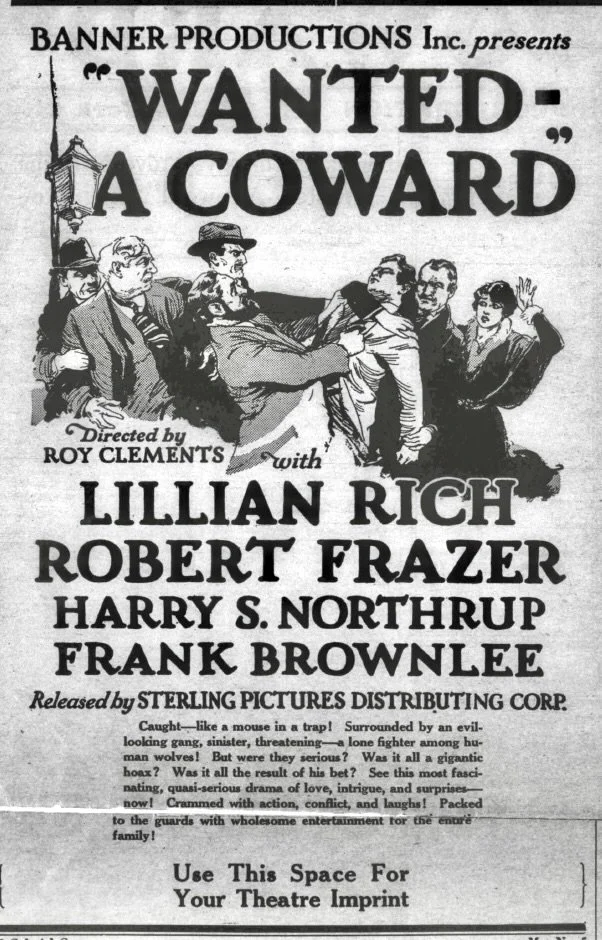
An ad for the film from the August 25, 1927 Alton Evening Telegraph in Alton Ill.
“Wanted—A Coward” became a six-reel silent movie that was released sometime in the late spring or early summer of 1927.
The film had staying power. Newspaper advertisements indicated it was still showing up on small-town movie screens for the next decade. It was often on double or even triple bills with other silents.
We also know that the film at one time was part of the Library of Congress collection.
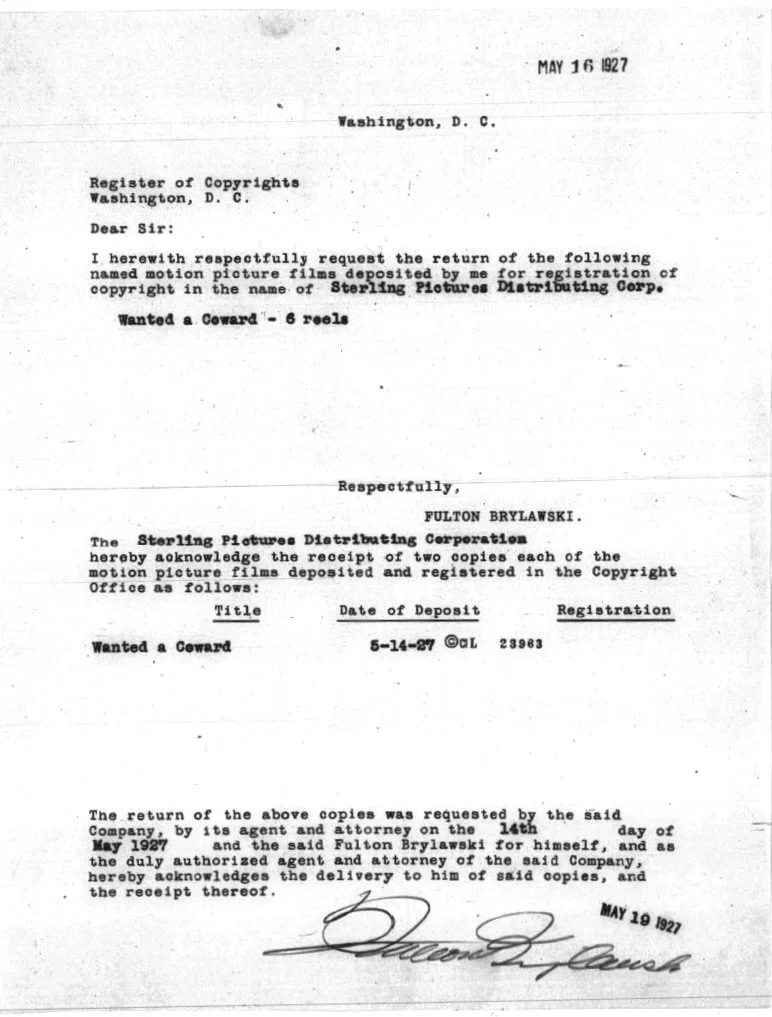
On file at the LOC is a letter and promotional material showing that the attorney for Sterling Pictures Distributing Corp. asked that the six reels on file at the library be returned to Sterling. The request shows the film was deposited on May 14, 1927.
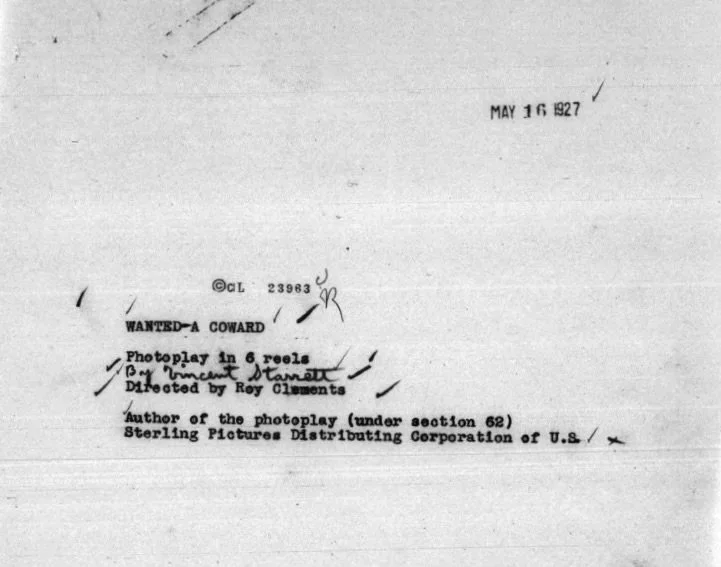
The library also has a cover note for the entry, which has Starrett’s name written by hand, as you can see here.
A summary of the film’s plot from the promotional packet at the Library of Congress.
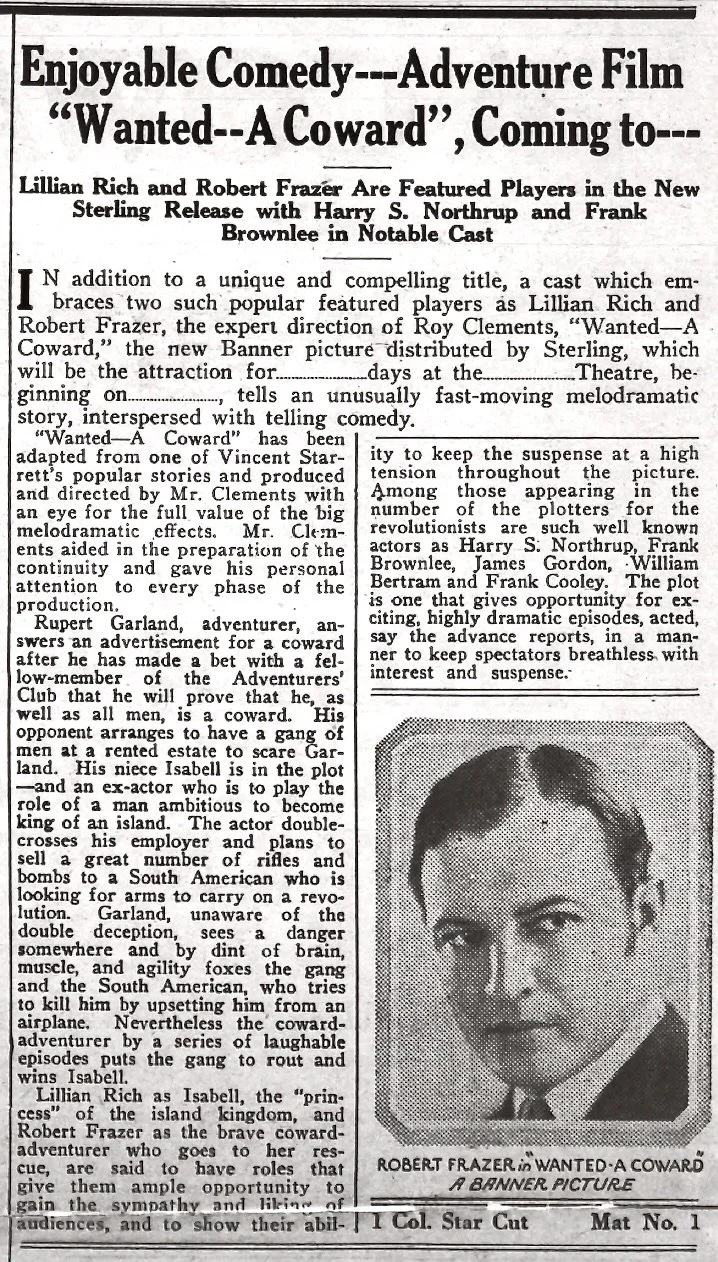
For me, the best discovery from the LOC is an impressive packet of the film’s promotional material. It appears to have been a large-scale newspaper-like production of several pages, with canned reviews, profiles of the actors and other details.
A helpful summary of the plot was also included, so we can get an idea of what movie-goers saw nearly 100 years ago when they plunked down a nickel for a ticket.
There were many details that were changed from the original story—especially the ending—but the framework appears to be the same.
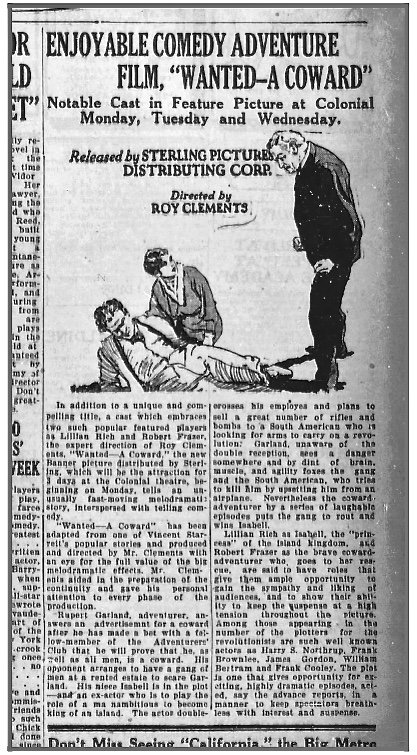
Until a copy of the film shows up—if that ever happens—that’s about all we can do for now, I leave you with a few other promotional details from the film, starting with an extended review from The Daily News of Lebanon, Pa., for July 23, 1927. The review reads a lot like the promotional material sent out by Sterling Pictures Distributing Corp.
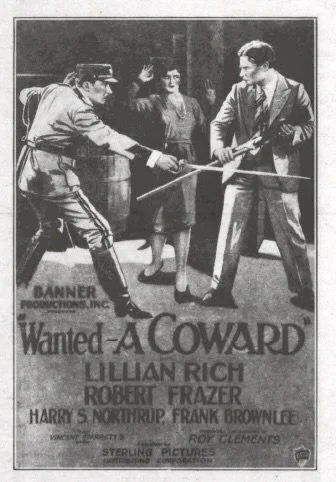
Another reproduction lobby card from “Wanted—A Coward.”