“Shall the world, then, be overrun by oysters?”
It is January 8, and if all is going well, there will be a large crowd gathered at the Grand Central Station Oyster Bar. We will be drinking beer, slurping down oysters and celebrating our shared enthusiasm for Sherlockian revelry.
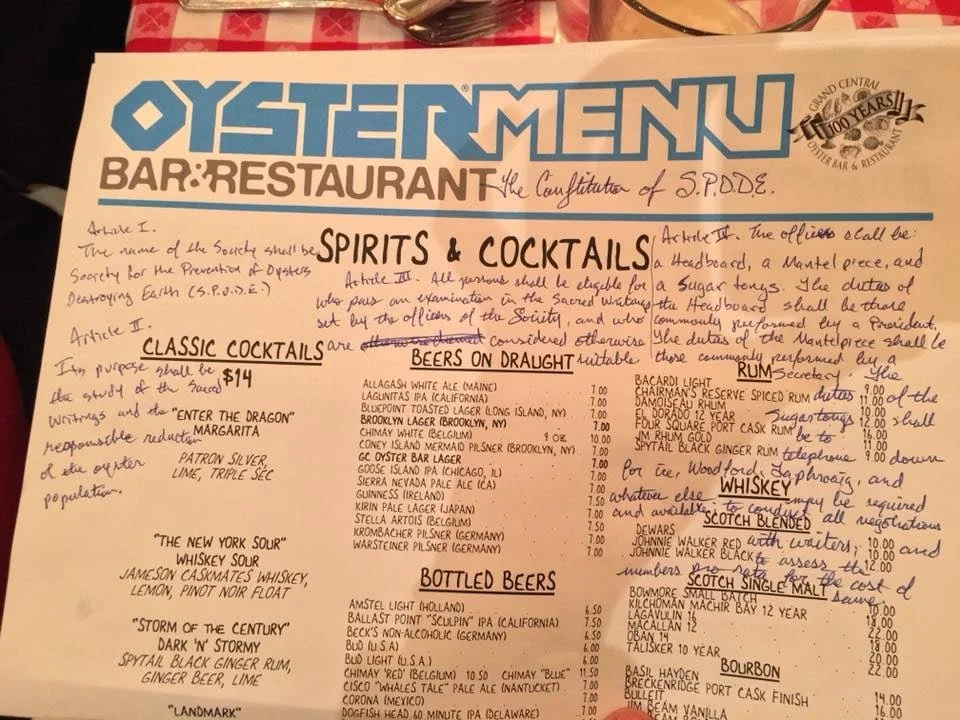
This is a meeting of S.P.O.D.E., The Society for the Prevention of Oysters Destroying the Earth. Informally running for more than 20 years, it was named and became an official scion of the Baker Street Irregulars in 2018. There are now scions of S.P.O.D.E. around the country, and, indeed, around the globe. And if all of this sounds a bit confusing and rather silly, well, welcome to S.P.O.D.E.
Tim Greer shows off his handiwork with the S.P.O.D.E. constitution. Like the Constitution and Buy-Laws of the Baker Street Irregulars, it is little known and completely ignored. Our only officer is Steven Doyle, the Headboard.
S.P.O.D.E. explained. Kinda.
I’ve had the honor of being around for most of the ride. In those early days we met under the aegis of Steven Doyle who organized (if that can be the right word for such irregular frivolity) the gathering. We were a small bunch and had no name and took up a relatively small table beneath the Guastavino tiled vaulted ceilings in the main dining room of the Oyster Bar.
We met on Saturday evenings in those days, and in my case, it was in part because I had no other offers and—in larger part—because I delighted in the company around the table. At the end of the meal, we got a bill, divided by the number of diners, and tossed cash onto the table.
It was all joy, beer, oysters, beer, pan roasts (with lots of paprika), beer and laughter.
A Saturday dinner at the Oyster Bar in our pre-S.P.O.D.E. days.
But as time went on, word got out that Sherlockians were having fun and others wanted to join. And so they did, continuing under the welcoming smile of Steve Doyle.
Soon, the crowd became so large that Steve had to set a limit on the size (25). We were moved into a back room of the restaurant, where a table large enough for us could be constructed, and that’s where we expect to find ourselves this evening.
I hope to be around the table once again.
‘No, no; horrible!’
The connection between Sherlockians and oysters is rooted in a few mumbled lines by a seemingly delirious Holmes during “The Adventure of the Dying Detective.”
Indeed, I cannot think why the whole bed of the ocean is not one solid mass of oysters, so prolific the creatures seem.… Shall the world, then, be overrun by oysters? No, no; horrible!
Which is why being ever vigilant in our efforts to keep down the oyster population became the principle mission of our little society.
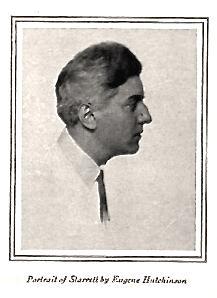
Sadly, Starrett’s essay on oysters was not called out on the cover of the Gold Book Magazine.
But for the friends of Vincent Starrett, there is an equally vital investigation into oysters which must be referenced here.
In September of 1934, Starrett published a piece in The Golden Book Magazine, describing the joy of consuming oysters. Careful readers will recall that The Golden Book magazine was the place where the first essay in what would become The Private Life of Sherlock Holmes was published. That was back in December of 1930, when The Golden Book Magazine was a large or broadsheet magazine.
By the autumn of 1934, the magazine had been downsized to a digest, a victim of the Great Depression. The magazine would fold the following year.
Men, Women & Oysters
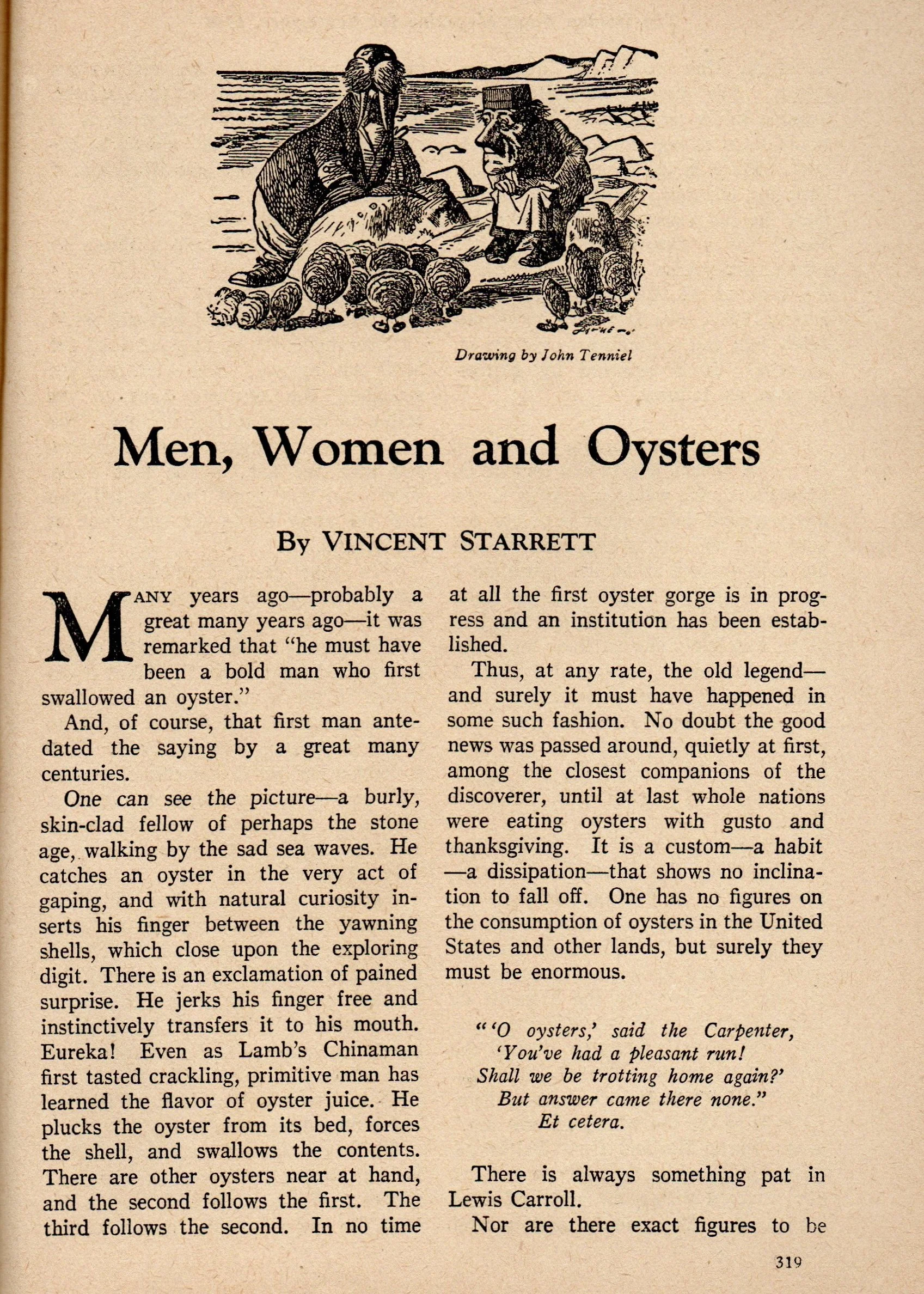
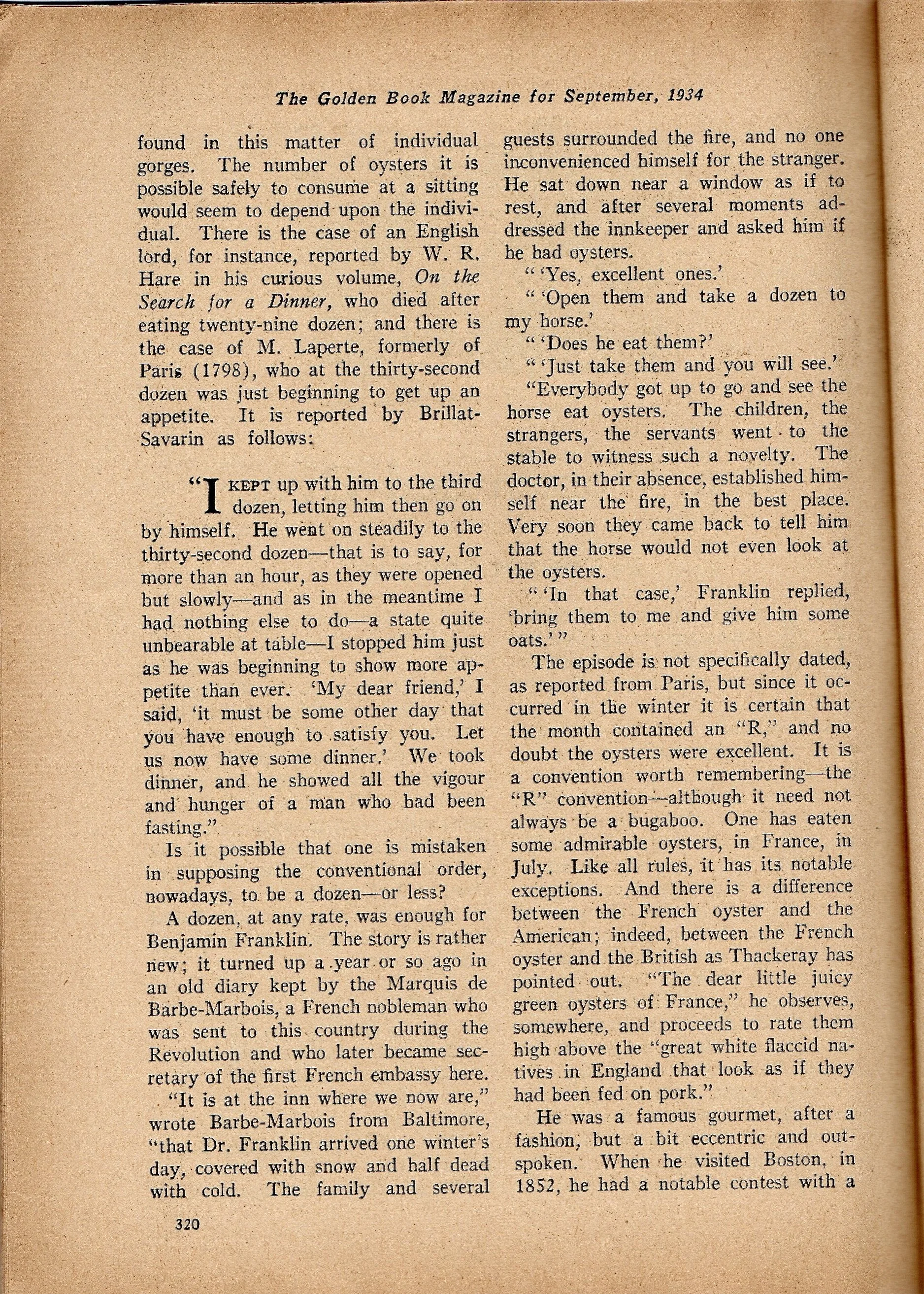
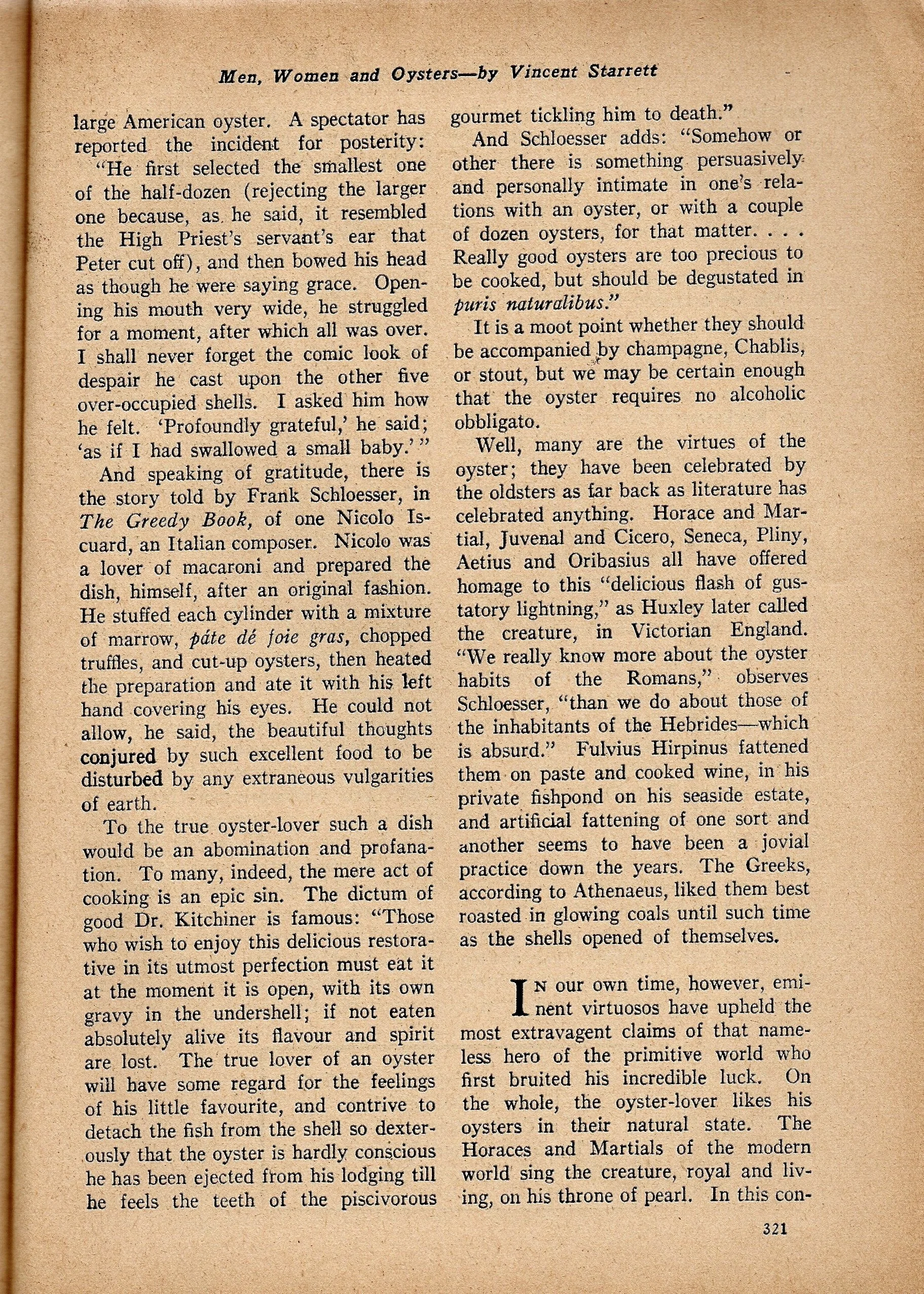
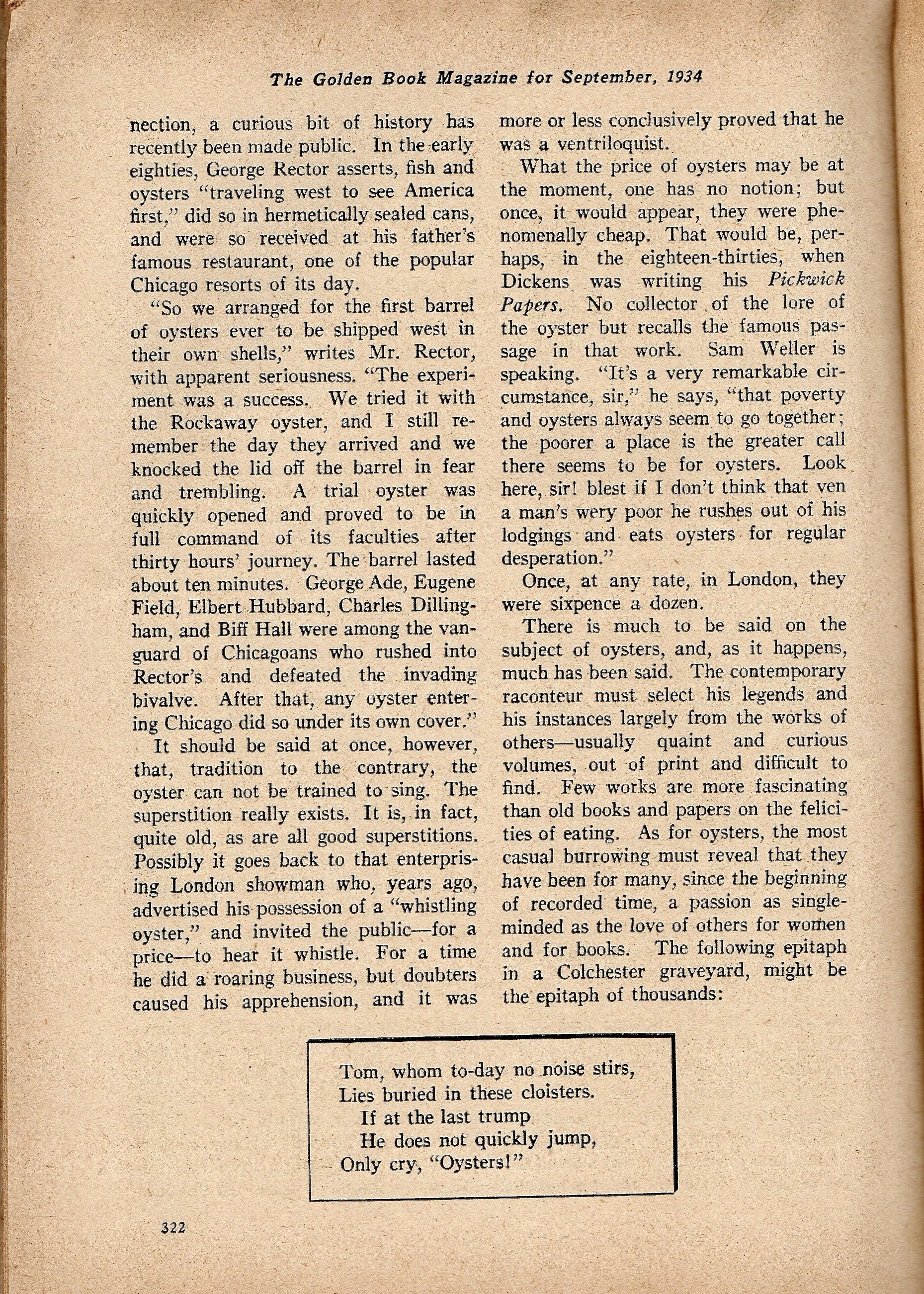
It was in this smaller version of the Golden Book Magazine that Starrett published an essay on “Men, Women and Oysters.” It is pleasant to note that the magazine’s editors picked a Sir John Tenniel illustration for the essay.
Tenniel, you will recall, is most famous for his Alice in Wonderland illustrations. This includes drawings for "The Walrus and the Carpenter," the poem Lewis Carroll wrote for Through the Looking-Glass.
In addition to the two characters in the title, Tenniel has a number of oysters listening attentively, not realizing that they were going to be the main course on the Walrus and Carpenter menu.
The bookplate of Julian Wolff, longtime leader of the Baker Street Irregulars. Clearly he was also enamored of the bivalve mollusks.
Those not familiar with the poem should seek it out in full. It occurs to me that if the annual S.P.O.D.E. gathering was a meeting in some secluded restaurant, a dramatic reading would be a natural item to place on the program.
But, (and this is why S.P.O.D.E. is so popular) there is no program at the meeting, aside from consuming large quantities of the devilish beasts amid great laughter and warming beverages.
Here are just a few verses:
“O Oysters, come and walk with us!’
The Walrus did beseech.
“A pleasant walk, a pleasant talk,
Along the briny beach:
We cannot do with more than four,
To give a hand to each.”
***
“O Oysters,” said the Carpenter,
“You've had a pleasant run!
Shall we be trotting home again?”
But answer came there none —
And this was scarcely odd, because
They'd eaten every one.
Feasting and Franklin
Starrett goes on to relate some rather startling statistics. For example, there was the case of an unnamed English lord who died after eating 29 dozen oysters in one sitting. (For those reaching for the calculator function on your cell phone, allow me: 29 X 12 = 348. Urp.)
Raw oysters, as they are presented for feasting at the Oyster Bar.
Starrett also reports that Ben Franklin used oysters in a rather unique fashion. Arriving at a Baltimore inn during a snow storm, he was forced to sit by the window since no one near the fire would allow him a seat to warm himself.
Thinking quickly, Franklin ordered a dozen oysters—for his horse! Everyone ran out to the stable to watch the novelty, while Dr. Franklin established himself in the warmest space next to the fire. When the crowd came in to report their disappointment that the horse didn’t even look at the oysters, the now toasty Franklin replied: “In that case, bring them to me and give him some oats.”
Raw vs. cooked
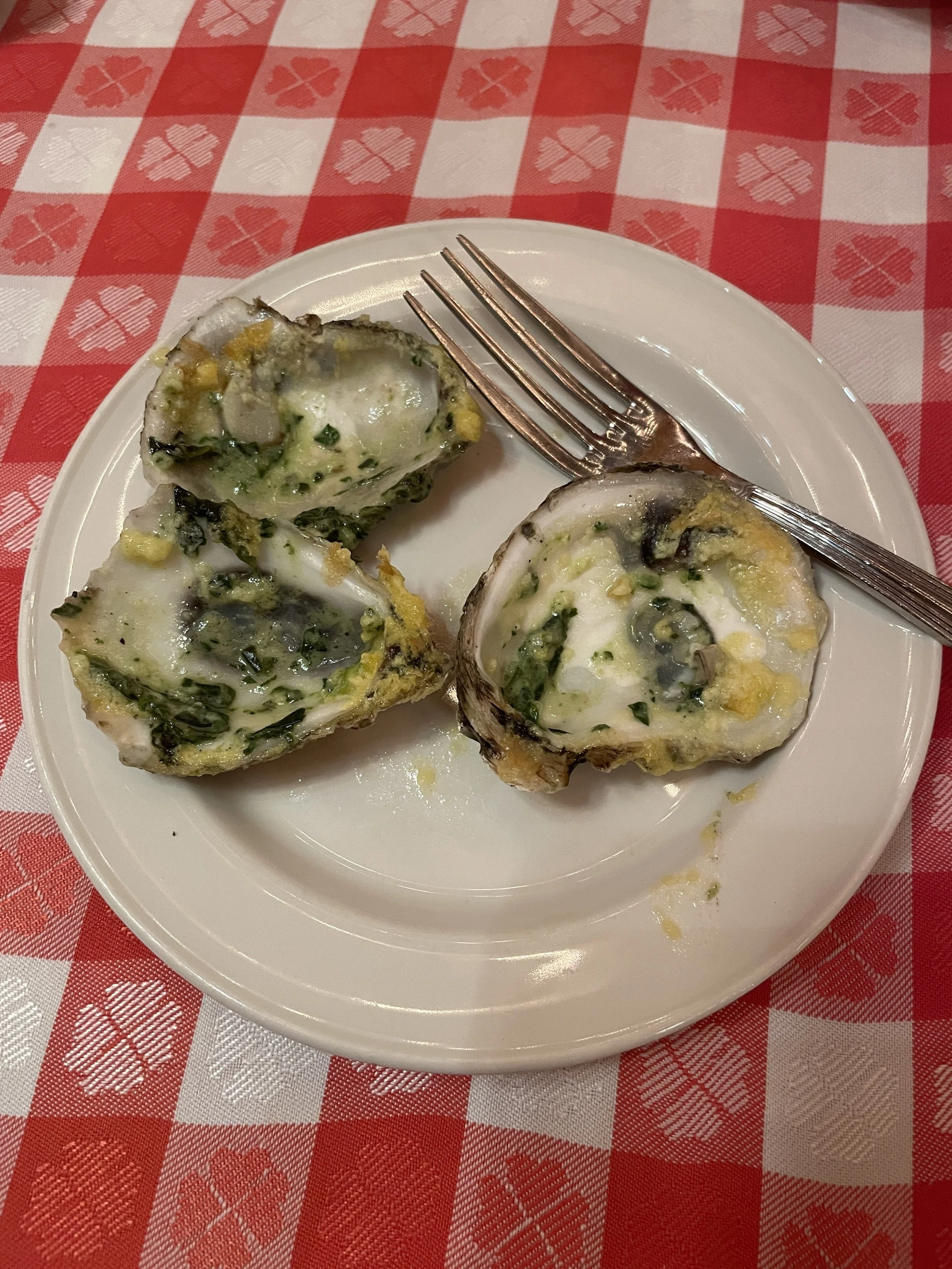
The remnants of a baked oyster appetizer, Mr. Doyle’s favorite. We do not hold with this method of eating oysters and prefer Dr. Kitchiner’s recommendation instead.
Starrett cites no less an authority that Dr. William Kitchiner, an optician and a celebrity chef of the 19th century, who made it clear that oysters should be eaten as soon as possible after the shell has been pried open.
Dr. Kitchiner’s 1817 cookbook, The Cook’s Oracle, was a best-seller on both sides of the Atlantic. He is not shy about stating his preference.
If not eaten absolutely alive, its flavour and spirit are lost.
The true lover of an oyster will have some regard for the feelings of his little favorite, and contrive to detach the fish from the shell so dexterously that the oyster is hardly conscious he has been ejected from this lodging till he feels the teeth of the piscivorous gourmet tickling him to death.
‘Speaking of Oysters’
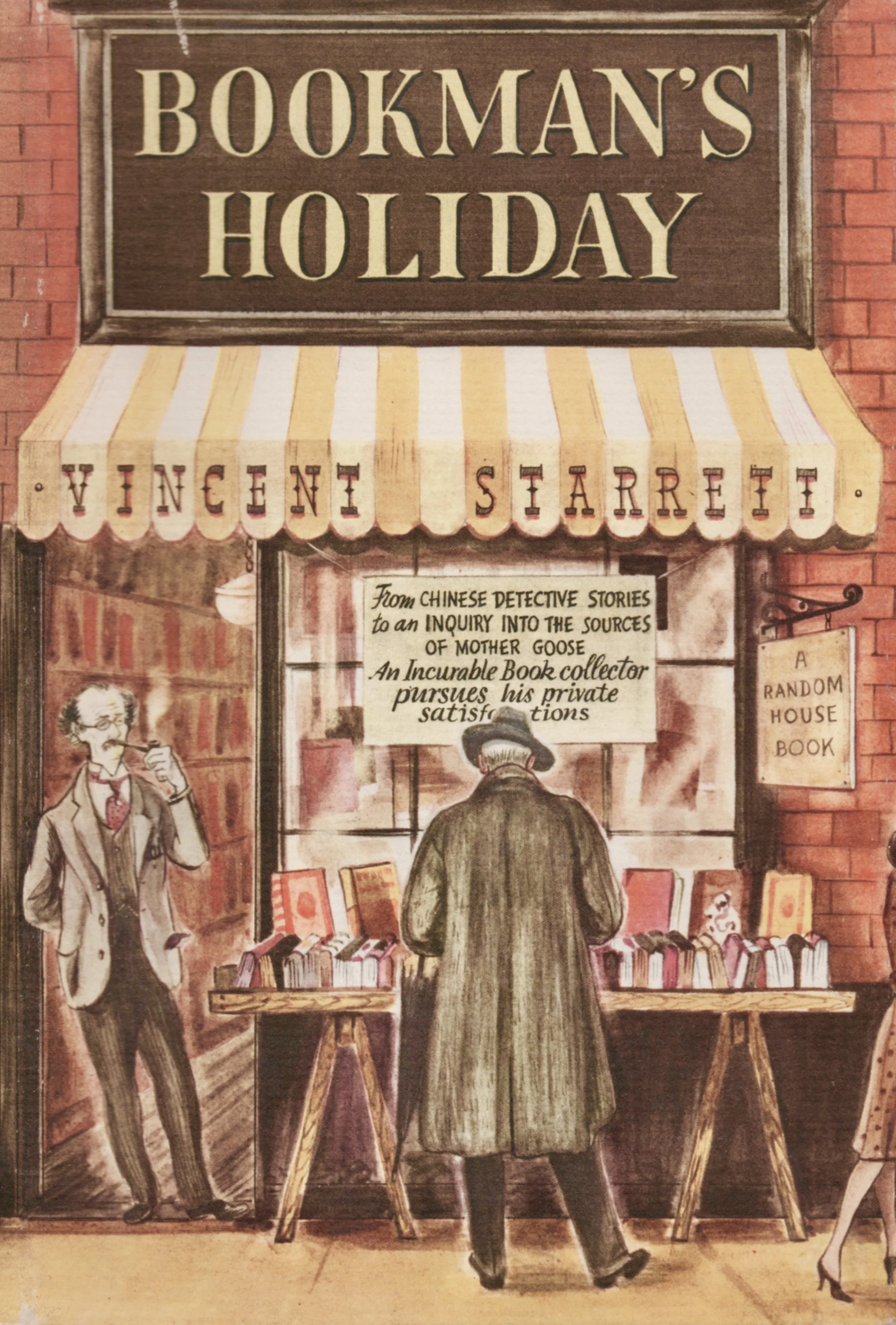
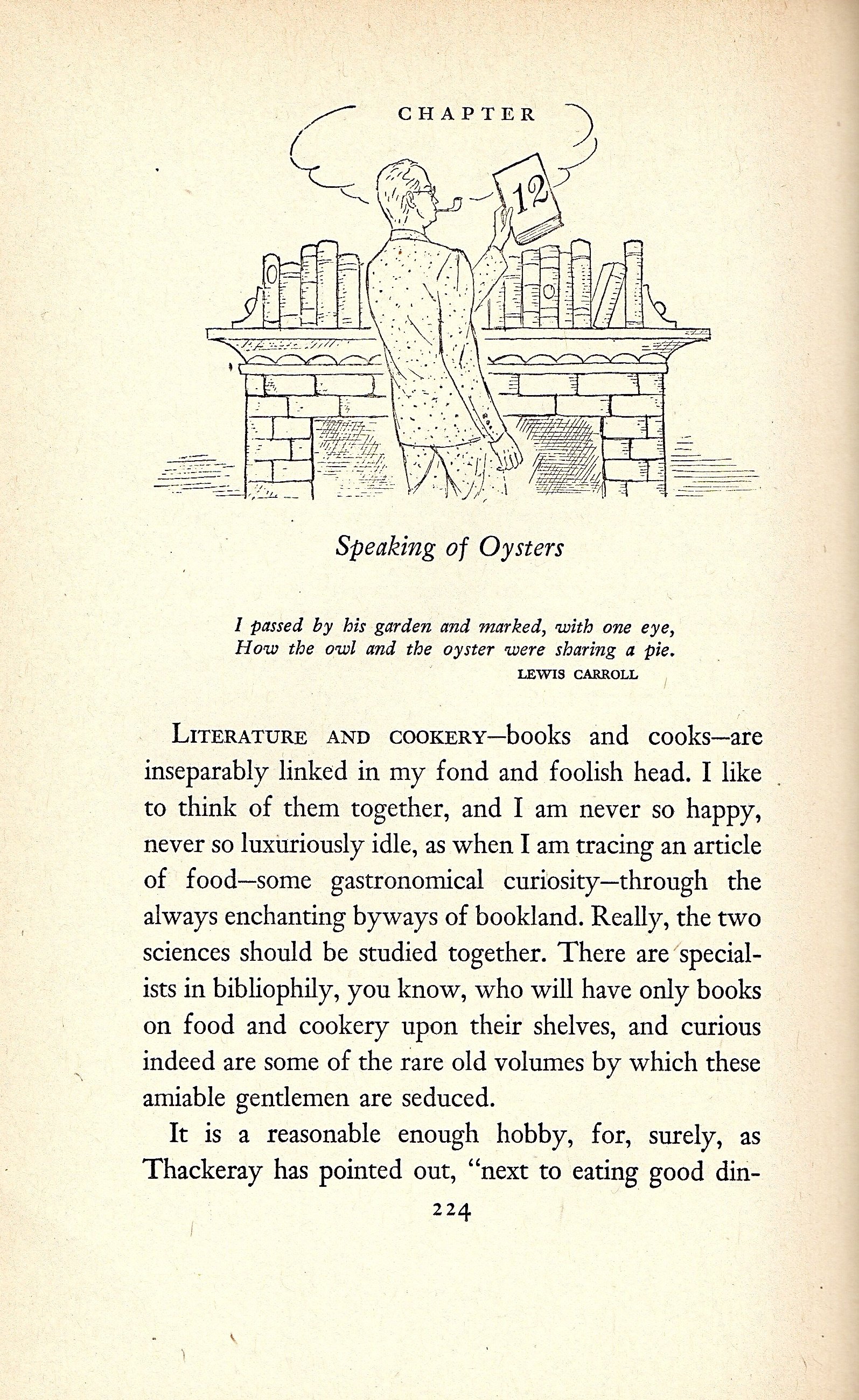
The Golden Book Magazine piece was largely recycled when it appeared several years later in an anthology of the author’s best essays. Starrett made several changes when the essay was headed for his 1942 collection, Bookman’s Holiday. The title shifted from “Men, Women and Oysters,” to “Speaking of Oysters.” He added a few introductory paragraphs to set up the oyster discussion, beginning with the delightful observation that,
Literature and cookery—books and cooks‚—are inseparably linked in my fond and foolish head. I like to think of them together, and I am never so happy, never so luxuriously idle, as when I am tracing an article of food—some gastronomical curiosity—through the always enchanting byways of bookland. Really, the two sciences should be studied together.
Who could disagree with such an observation? It would also lead to this delightful dialogue:
Q: What did you study in university?
A: I majored in books and cooks.
‘The World’s Mine Oyster’
What started Starrett on his oyster hunt? He suggests several possibilities.
Possibly it was “The world’s mine oyster,” from the Merry Wives, that put my nose to the trail, or “Love may transform me to an oyster,” from Much Ado—I don’t remember. But it is extraordinary how the silent creature has colored the pages of literature and history.
He then launches back into the essay that had appeared in the Golden Book more than 9 years earlier. He made other changes along the way, but it’s generally the same essay, expounding on the long and glorious history of the oyster through literature, and proving that, unlike oysters themselves, essays about oysters can be endlessly recycled.
Among the differences is the addition of an oyster-related epitaph carved into a headstone which Starrett claims to have found in a graveyard in Colchester, England.
“Tom, whom to-day no noise stirs,
Lies buried in these cloisters;
If at the last trump
He does not quickly jump;
Only cry, ‘Oysters!’ ”
The opening page to Frank Schloesser’s 1906 tribute to oysters.
In fact, Starrett found the epitaph in a book, The Greedy Book: A Gastronomical Anthology, written by Frank Schloesser and published in 1906 by Gay and Bird of London. We know this because several of Starrett’s anecdotes about oysters are taken, sometimes word-for-word, from Schloesser’s essay.
As you can see here, Schloesser used the epitaph to introduce his chapter on oysters.
The Final Problem
Why was Holmes not included in Starrett’s ruminations on oysters and literature?
Which leaves us with one unresolved mystery.
Vincent Starrett, who surely knew the Sherlock Holmes canon from start to finish, had two opportunities to introduce the master detective’s faux delirium ravings about oysters, but did not.
That is a shame. Sherlock would have fit in well with Dr. Franklin, Dr. Kitchiner and dear dead Tom.
Why Holmes was left out is something I will reflect upon this year as I sit down with friends to once again battle the prolific mollusks.
Oh, if you should ever find yourself in Williamsburg, Virginia, let me invite you to a meeting of LORE, the local chapter of S.P.O.D.E. We not only devour oysters, we drink an excellent and peaty Scotch whisky of the Laphroaig family known as Lore.
Raise a glass!
The official designation of LORE as a scion of S.P.O.D.E.