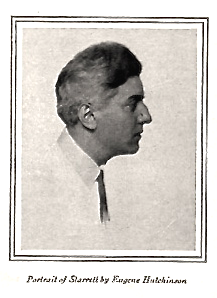
The Good Old Days
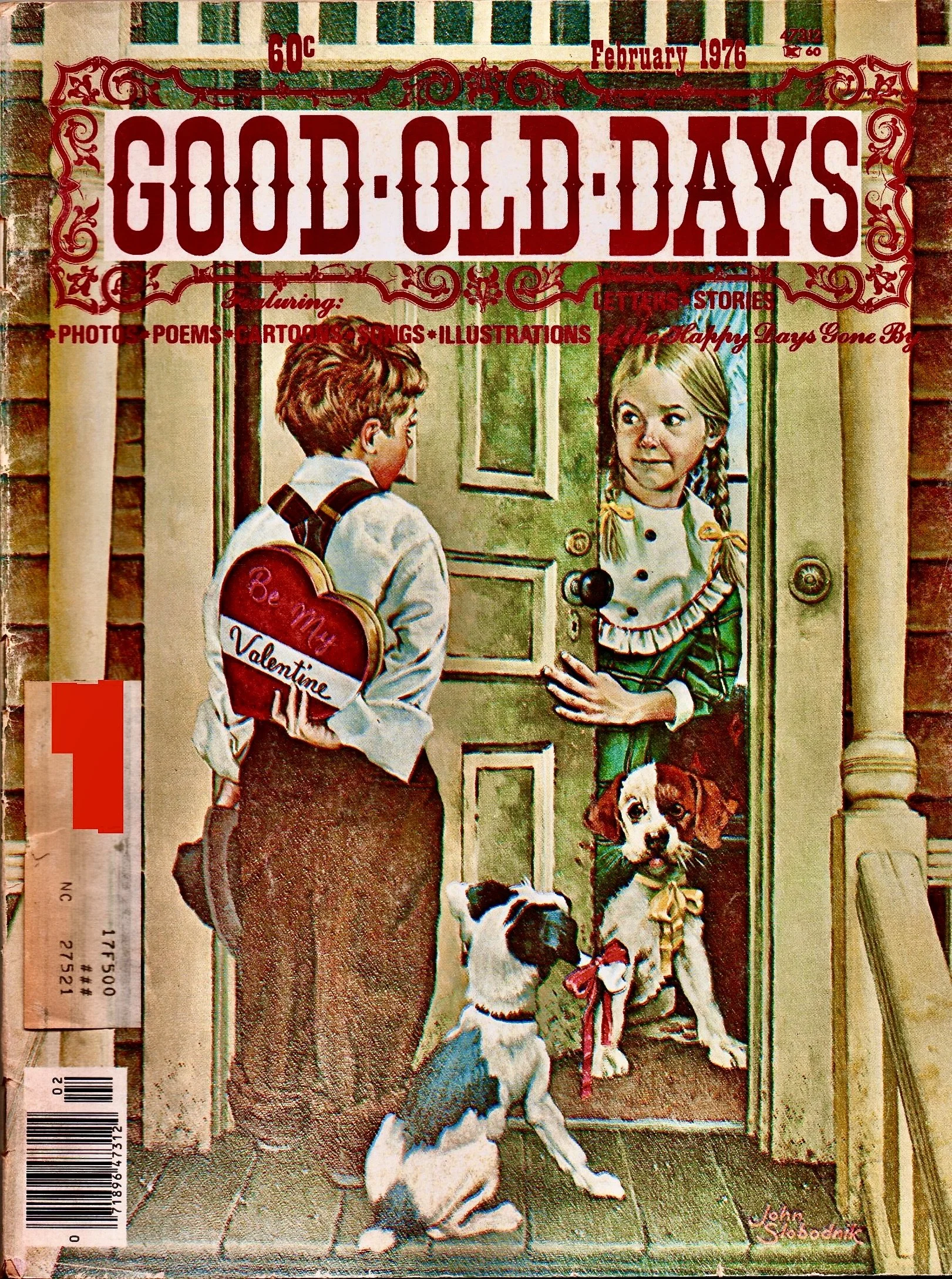
Not long ago I added a little magazine to the Vincent Starrett collection. I bought it online, and—to be completey candid—did not think much about some of the information in the ad. I only knew that I didn't have this particular magazine and was curious to see what it was.
The price was modest, so I figured I would give it a try.
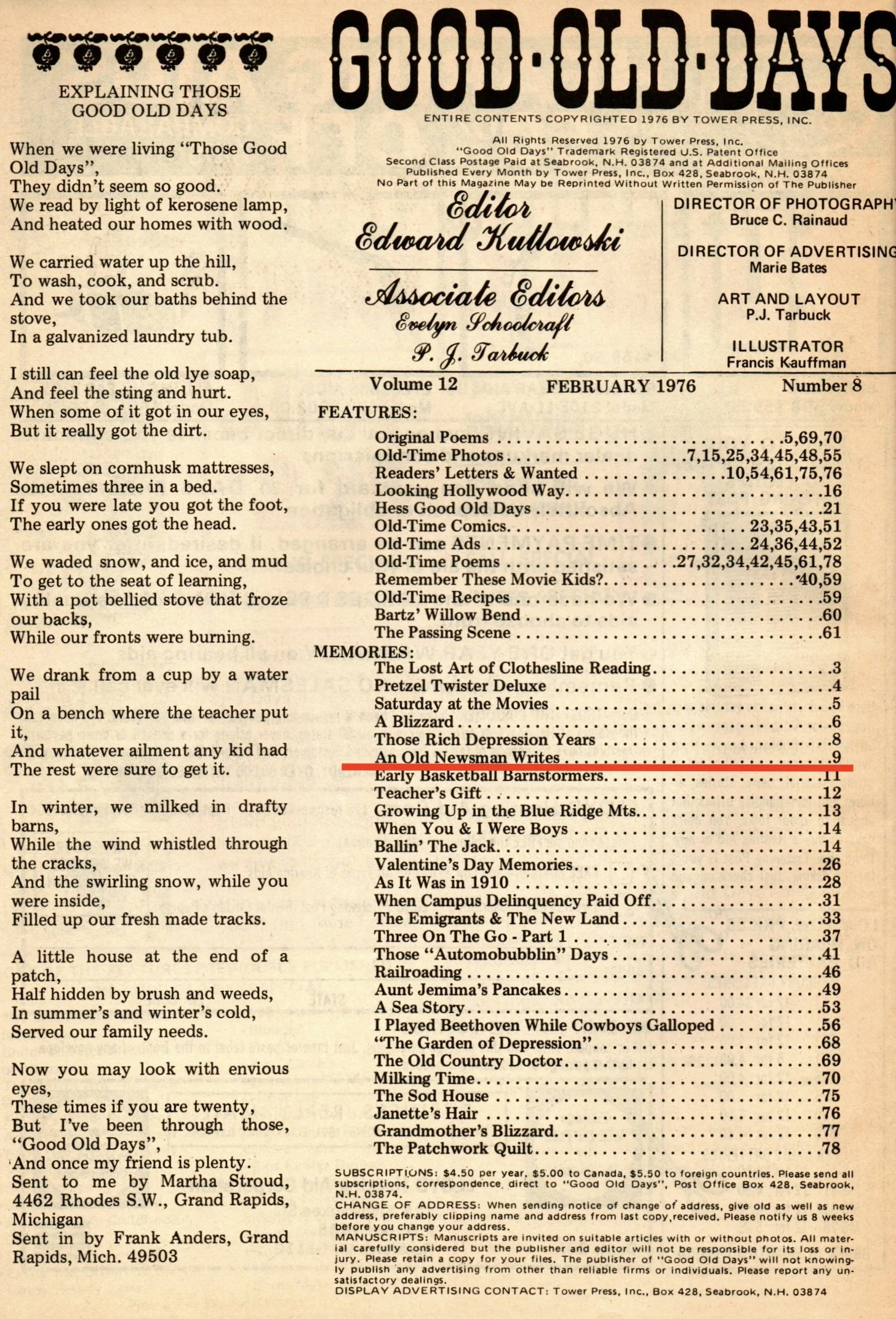
A few days later a sturdy envelope with a copy of Good Old Days magazine arrived at my door. The magazine’s cover was a bit faded, but otherwise it was in good shape for its age. I flipped it open and found the table of contents.
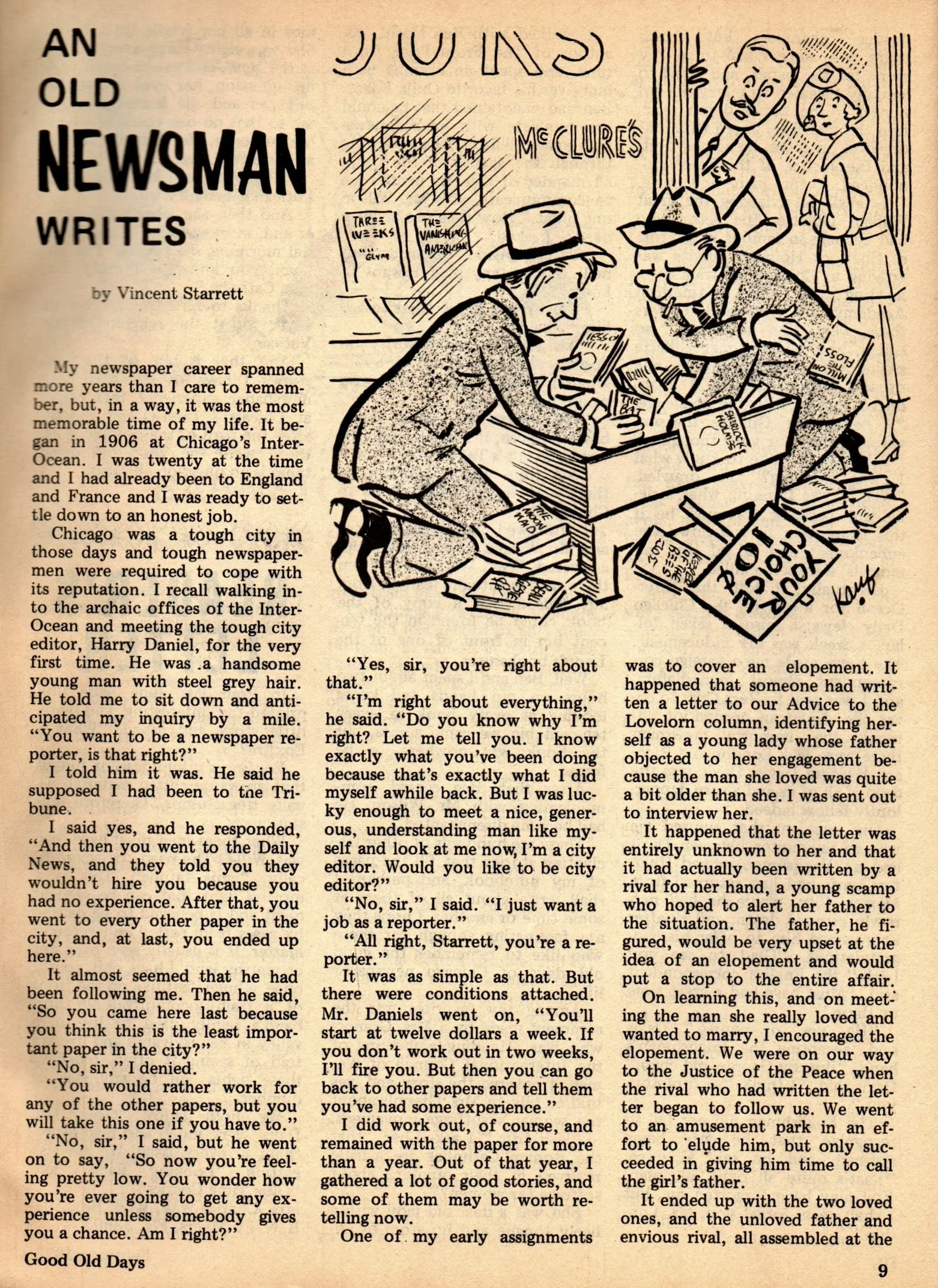
The first page of the article attributed to Starrett.
There were no names on any of the articles but it felt right that the one titled, “An Old Newsman Writes” would be something in Starrett’s wheelhouse. Sure enough, I flipped to page 9 and there it was: “An Old Newsman Writes” by Vincent Starrett.
The accompanying illustration was attributed to “Kauf,” no doubt Francis Kaufman, who was listed in the contents page as the magazine’s illustrator.
As I started to read through the piece, it was clear this was something that was cobbled together from Starrett’s memoir, Born in a Bookshop, published in 1965 by the University of Oklahoma Press.
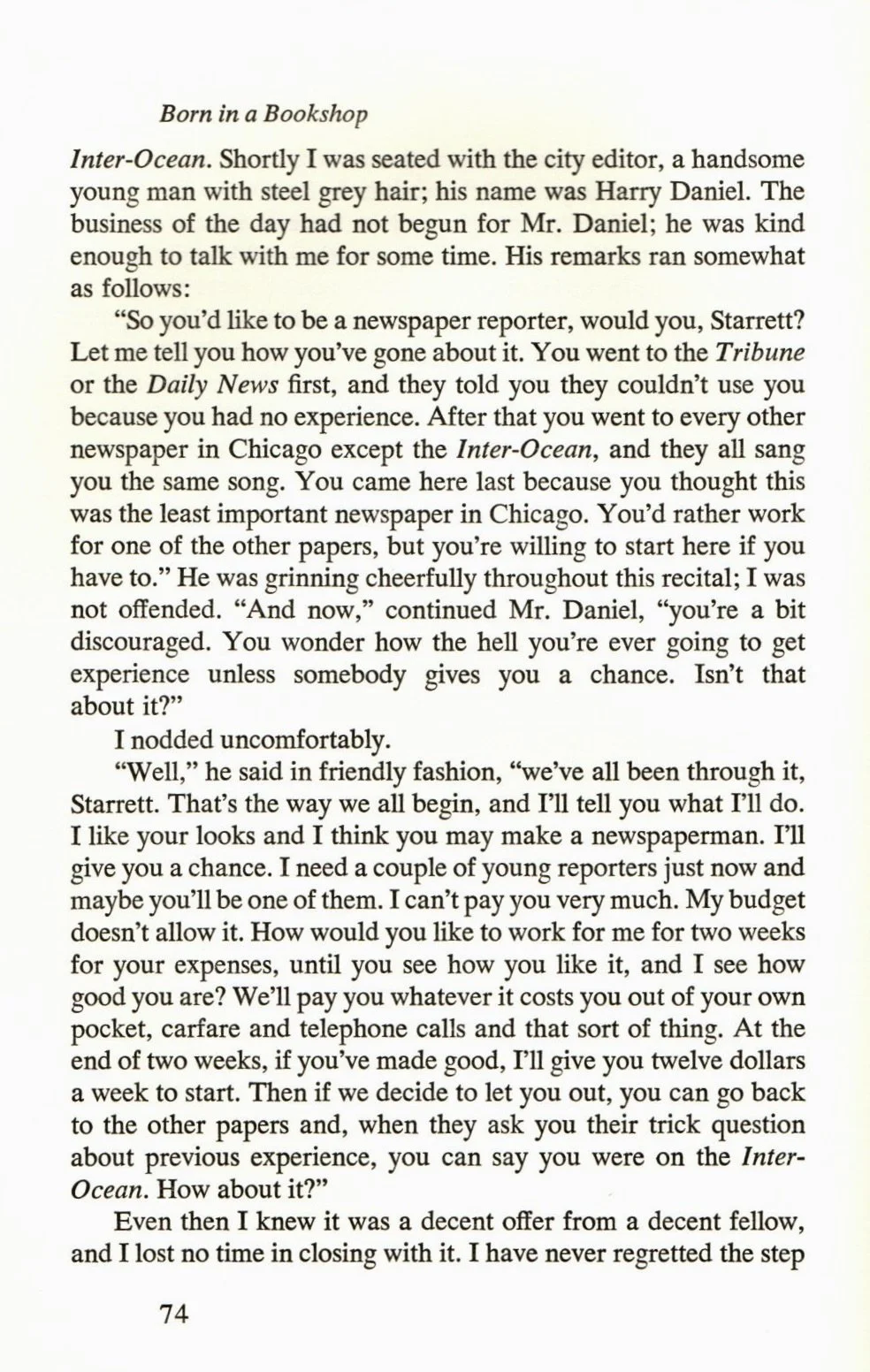
Page 74 of Starrett’s memoir, Born in a Bookshop.
The more I read, the curiouser the whole business became. The anecdotes had been rewritten to cut them down for a magazine format. Even the quotes had been changed, although they carried about the same meaning.
Take the first story about Starrett trying to get hired as a reporter. He had gone through every newspaper in the city (there were more than 20 at the time, this being the early 1900s) and striking out at every one.
He then went to the last on his list, and recounts being interviewed by Harry Daniel, city editor for the (now long gone) Chicago Inter-Ocean newspaper. Here’s how it starts in the magazine:
I recall walking into the archaic offices of the Inter-Ocean and meeting the tough city editor, Henry Daniel, for the very first time. He was a handsome young man with steel gray hair. He told me to sit down and anticipated my inquiry by a mile. ‘You want to be a newspaper reporter, is that right?’
And here is how the meeting starts in his memoir:
At length, there was only one newspaper left, the Inter-Ocean. Shortly I was seated with the city editor, a handsome young man with steel grey hair; his name was Harry Daniel. . . . His remarks ran somewhat as follows:
‘So, you’d like to be a newspaper reporter, would you, Starrett? Let me tell you how you’ve gone about it. . . .’
And so on.
That’s not the only rewrite going on here.
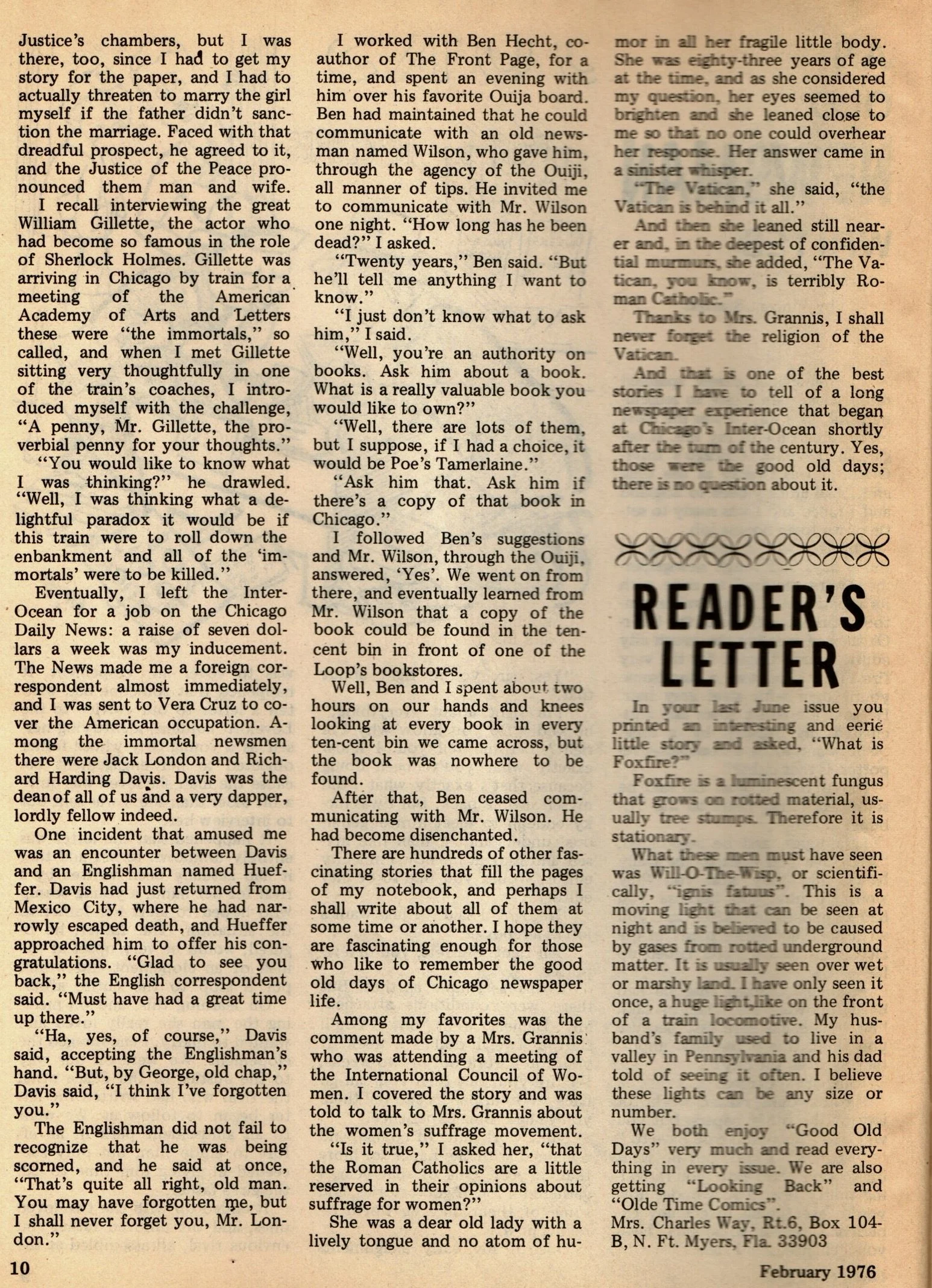
The second page of the magazine piece attributed to Starrett
For example, here’s how the magazine version recounts his first meeting with William Gillette, whose performance as Sherlock Holmes stamped an indelible image of the great detective on American brains for generations.
The meeting took place as Gillette and Starrett were traveling by train to a gathering of the American Academy of Arts and Letters. Gillette would be honored by the group as one of the nation’s “Immortals” at the event.
Here is how it begins in the magazine:
I introduced myself with the challenge, ‘A penny, Mr. Gillette, the proverbial penny for your thoughts.’
‘You would like to know what I was thinking?’ he drawled, ‘Well, I was thinking what a delightful paradox it would be if this train were to roll down the embankment and all of the “immortals” were killed.’
The meeting in Starrett’s memoir goes as follows:
Good morning, Mr. Gillette,’ I said; and added cleverly, for I was young and clever, ‘A penny for your thoughts.’
His eyes lighted and his face crinkled. ‘You would like to know my thoughts, young man?’ said William Gillette. ‘I was thinking what a delightful paradox it would be if this train were to roll down the embankment and all the Immortals were to be killed!’
Now Starrett was well known for his ability to recycle old material into new articles.
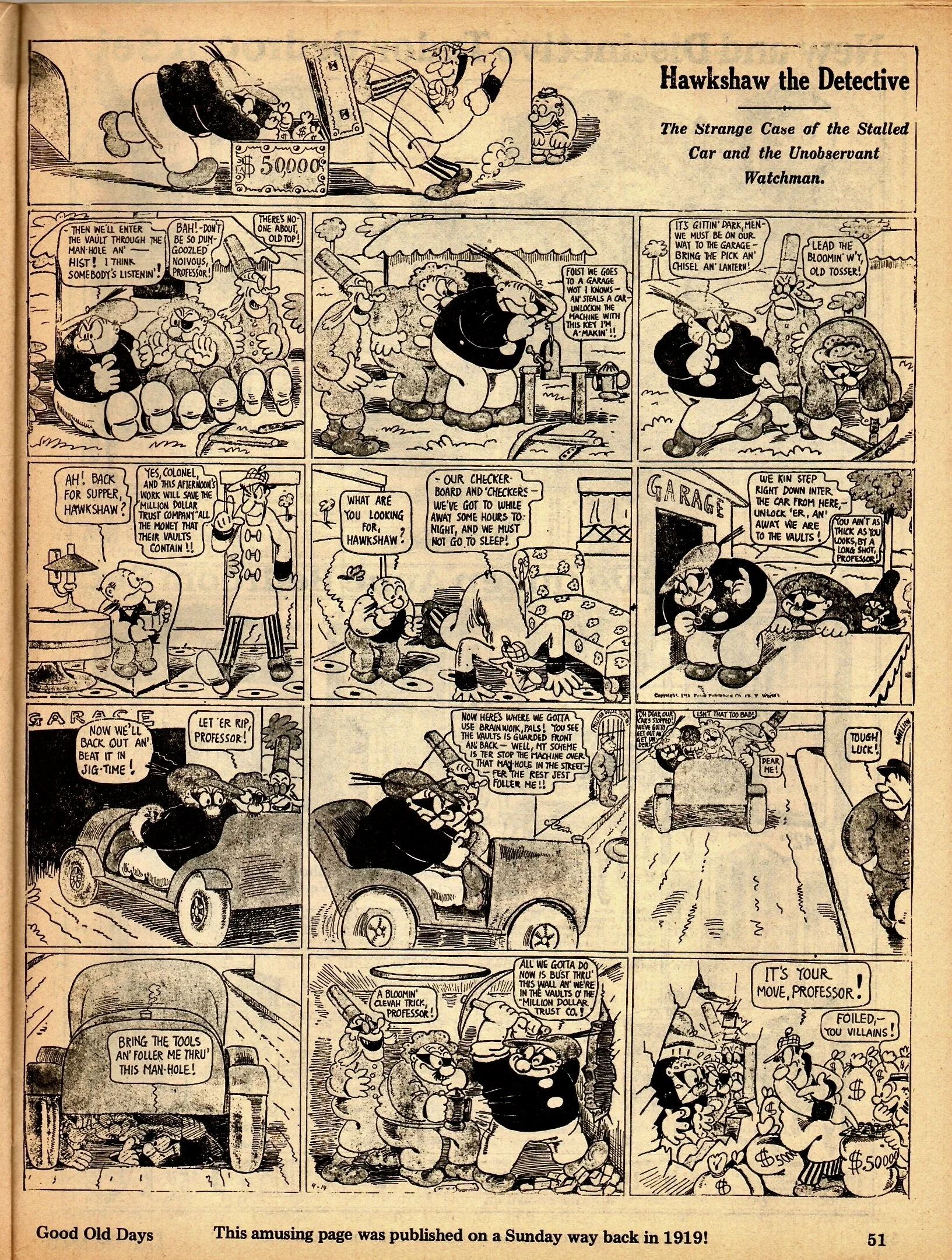
The same issue of Good Old Days magazine reran a 1919 cartoon featuring Hawkshaw the Detective, a comic take on Sherlock Holmes. “The Strange Case of the Stalled Car and the Unobservant Watchman,” reads like a take on “The Adventure of the Red-Headed League,” with checkers substituting for whist.
Any working writer of the day did it, as a handy way of creating multiple articles and essays for different publications without having to do too much additional research.
That is not what’s remarkable about this piece in the Good Old Days magazine. What is remarkable, is that it was published in 1976, two years after Starrett died.
Those of you who are acquainted with Arthur Conan Doyle know that in the last decades of his life, he roamed the globe proselytizing on behalf of Spiritualism. Conan Doyle believed it was possible to contact the spirits of the dead and engage them in conversation. Some spirits engaged in “automatic writing,” prompting the mediums to write letters, articles even whole books! (See Pheneas Speaks.)
Was Starrett writing from the grave? I doubt it. There are more credible explanations.
Of course, it’s possible Starrett wrote the piece late in life and Edward Kutlowski, editor of Good Old Days, had held on to it for a few years.
But it is at least as likely that someone else sent in the article and attributed it to Starrett.
And, while I have no evidence to back it up, it sounds like the kind of thing that Michael Murphy, Starrett’s old friend, could have done.
Whoever sent it in didn’t make much money for their effort.
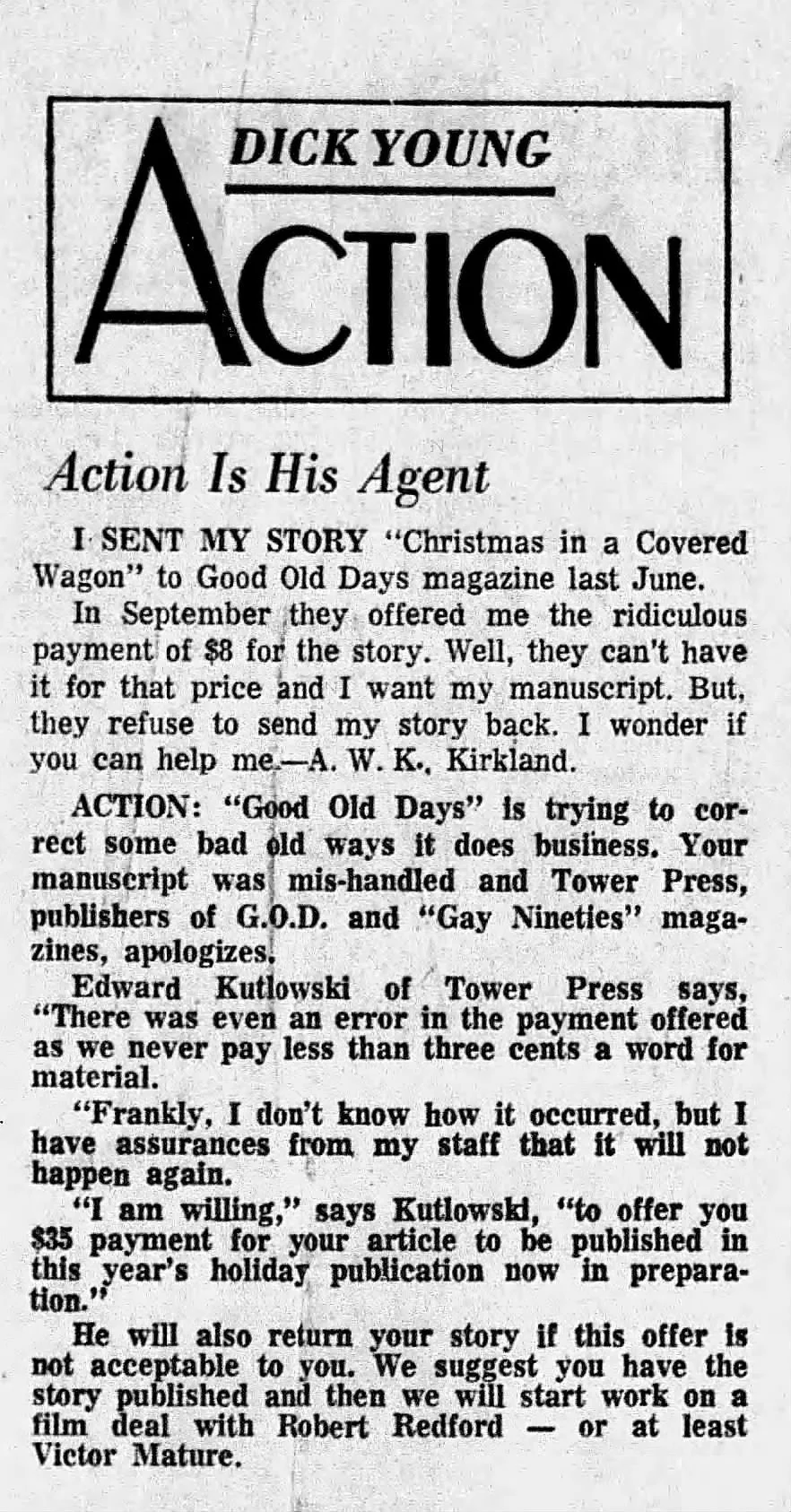
Here’s an article from the Seattle Post-Intelligencer for May 20, 1976, the same year this “Starrett” piece was published.
As you can see, Kutlowski didn’t pay much, when he paid anything at all.
The good old days might be fun to recall, but they aren’t going to make anyone rich. Except, perhaps, Mr. Kutlowski.
Ah well, it was an amusing way to spend an evening for me. And I have to say that I enjoyed the Hawkshaw the Detective cartoon (see above) as much as the supposed “Starrett” article.